SDMS vs. LIMS vs. ELN: Understanding the Differences and How They Work Together
 Request a Demo
 Download Brochure
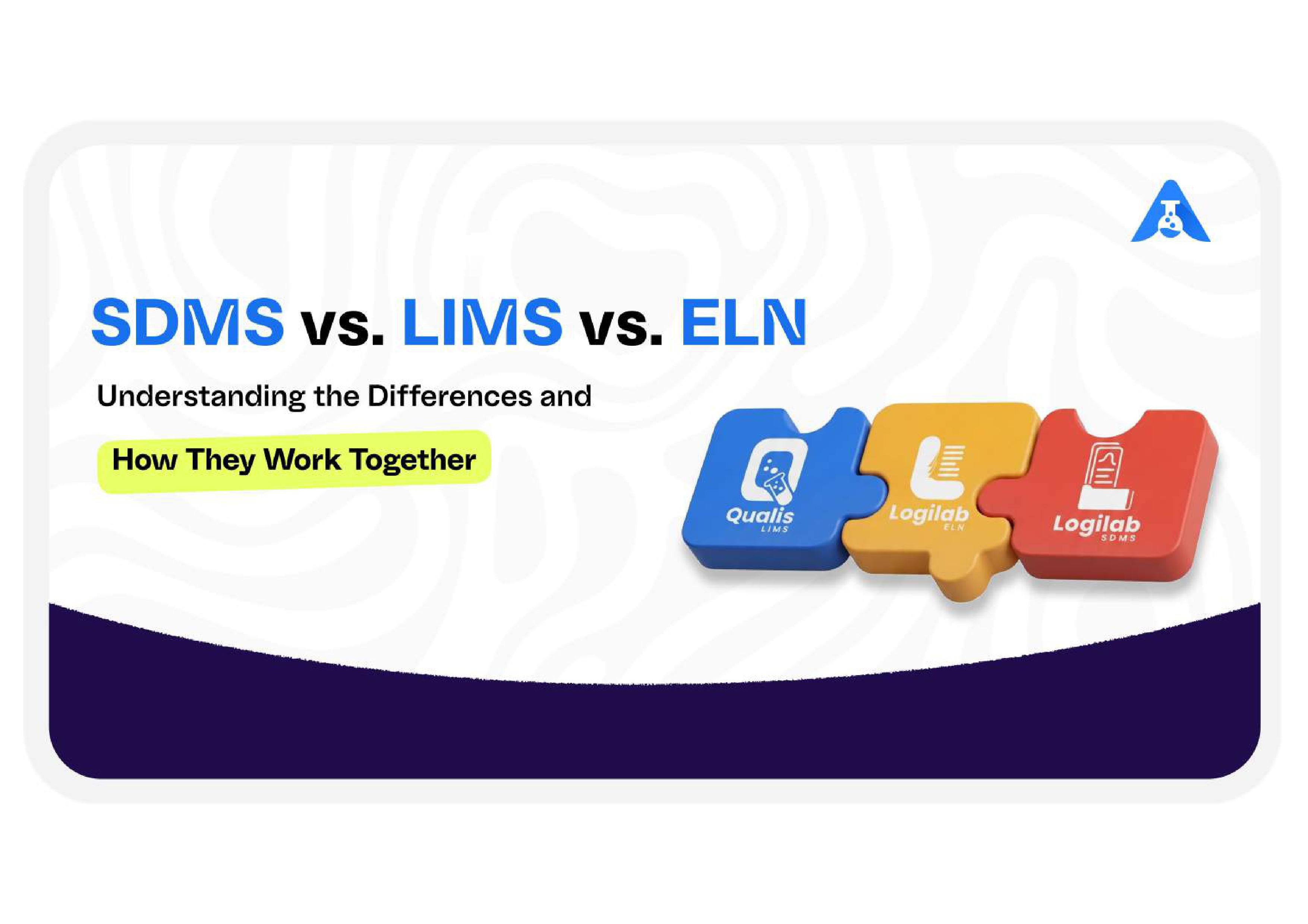
Ask three laboratory managers where a result “lives” and you may get five different answers. One will point to the LIMS, another to a notebook entry, and a third to a folder on an instrument PC. This confusion is common because laboratory informatics systems overlap in the eyes of many teams, even though each one was built to solve a different problem. Understanding SDMS vs LIMS vs ELN is the first step toward a lab that is paperless, traceable, and ready for inspection.
This guide explains what each system does, compares them side by side, and shows how they work together as a connected pipeline. It also explores how an integrated laboratory informatics environment can reduce manual handoffs, improve data traceability, and create a more connected workflow across laboratory operations.
SDMS vs LIMS vs ELN: What Does Each System Do?
LIMS
A Laboratory Information Management System (LIMS) manages the lifecycle of a sample. It tracks samples from registration and testing through result validation and reporting, making it a core system for laboratory workflow and sample tracking.
A LIMS software can also manage test methods, specifications, user roles, inventory, stability studies, non-conformance, OOS investigations, and Certificates of Analysis (CoA). With features such as audit trails, access controls, electronic approvals, and data integrity controls, LIMS helps laboratories meet regulatory compliance requirements in pharmaceutical, biotechnology, and other regulated environments.
Explore How LIMS Simplifies Sample and Workflow Management.
ELN
An Electronic Laboratory Notebook (ELN) manages experiments and scientific documentation. It replaces paper notebooks with digital workspaces where scientists record procedures, observations, calculations, results, and experimental decisions.
ELN software can support templates, protocol management, collaboration, electronic signatures, audit trails, and version control. These capabilities help laboratories maintain traceable experimental records and support regulatory compliance, including applicable requirements such as 21 CFR Part 11 and EU Annex 11.
Download ELN Brochure to Simplify Research Documentation.
SDMS
A Scientific Data Management System (SDMS) manages scientific and instrument-generated data. It captures, organizes, stores, indexes, and retrieves raw files, reports, images, and associated metadata from laboratory instruments.
An SDMS software helps centralize data that might otherwise remain scattered across instrument PCs, network folders, and other storage locations. Features such as access controls, audit trails, version history, data retention, and controlled archiving help maintain data integrity, traceability, and regulatory compliance.
SDMS vs LIMS vs ELN: Understanding the Key Differences
SDMS, LIMS, and ELN are all important laboratory informatics systems, but they manage different types of information and support different parts of the laboratory workflow. These systems address different parts of the laboratory data lifecycle and work together to provide a more connected environment.
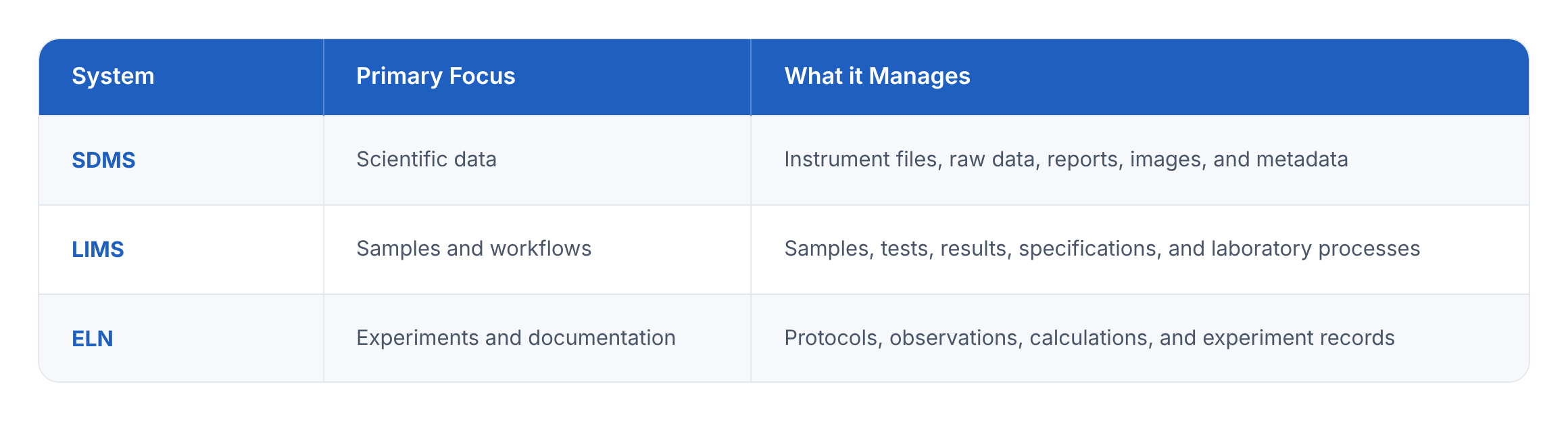
An SDMS software focuses on the scientific data generated by instruments and laboratory applications. It captures, organizes, stores, indexes, and retrieves raw data and associated metadata.
A LIMS software focuses on the sample and its journey through the laboratory, from registration and testing to result review and reporting. An ELN software focuses on the experiment, allowing scientists to document procedures, observations, calculations, and conclusions.
For instance, a LIMS software may show that a sample was tested and that the result met its specification. The SDMS software can store the original instrument file generated during that test, along with the associated metadata, i.e., a LIMS manages the sample and its workflow while an SDMS manages the scientific data generated during that workflow.
Similarly, an ELN software may document an analytical procedure and record the resulting observation, while the SDMS software stores the original chromatogram, spectrum, image, or instrument output supporting that observation i.e., an ELN software captures the experimental context while an SDMS software preserves the underlying scientific data.
Explore How SDMS Automates Instrument Data Capture
How SDMS, LIMS and ELN Work Together
SDMS, LIMS, and ELN are most effective when they work as connected systems rather than separate applications. Each system manages a different part of the laboratory data lifecycle, and integration allows information to move between them without repeated manual entry.
In an integrated laboratory environment, Logilab SDMS captures raw data generated by laboratory instruments and extracts relevant structured values from those files. Through REST APIs and other integrations, this information can be made available to downstream laboratory applications.
When an analyst receives a work allocation in Qualis LIMS, the associated Logilab ELN sheet can use the instrument values captured by the SDMS. This allows analysts to perform calculations and complete required procedures without manually retyping instrument results. The ELN record can also be linked directly to the verified raw data file stored in the SDMS repository.
Once the results are reviewed and validated, they can be returned to Qualis LIMS for specification checks, approval, and final release. This creates a connected workflow in which data is captured once and reused across the laboratory.
The integration can extend beyond the laboratory as well. Structured quality data can flow from the laboratory systems to MES, ERP, or SAP systems, helping support downstream processes such as manufacturing workflows and batch release.
Conclusion
The question of SDMS vs LIMS vs ELN is ultimately not about choosing one system over another, but about understanding how each fits into the laboratory data lifecycle. LIMS manages the sample and workflow, ELN captures the experiment and scientific context, while SDMS preserves the original instrument data and supporting records. When these systems work together, laboratories can reduce data silos and manual handoffs while creating a traceable flow from instrument data to validated result and CoA. The right combination depends on the laboratory's workflows, data volumes, instruments, and compliance requirements, but the goal remains the same: making laboratory data easier to capture, connect, manage, and retrieve.
What if your data could find its way without you? See how SDMS, ELN, and LIMS work together to connect raw instrument data to validated results and CoA without the data chase. Book a personalized SDMS demo and see a connected laboratory workflow in action.
- SDMS vs LIMS vs ELN: What Does Each System Do?
- LIMS
- ELN
- SDMS
- SDMS vs LIMS vs ELN: Understanding the Key Differences
- How SDMS, LIMS and ELN Work Together
- Conclusion