What is SDMS? Complete Guide to Scientific Data Management Systems
 Request a Demo
 Download Brochure
Managing the growing volume of scientific data is a major challenge for modern laboratories. When instrument files, test results, experimental records, and supporting documents are scattered across different systems, finding the right data can quickly become time-consuming and difficult to manage.
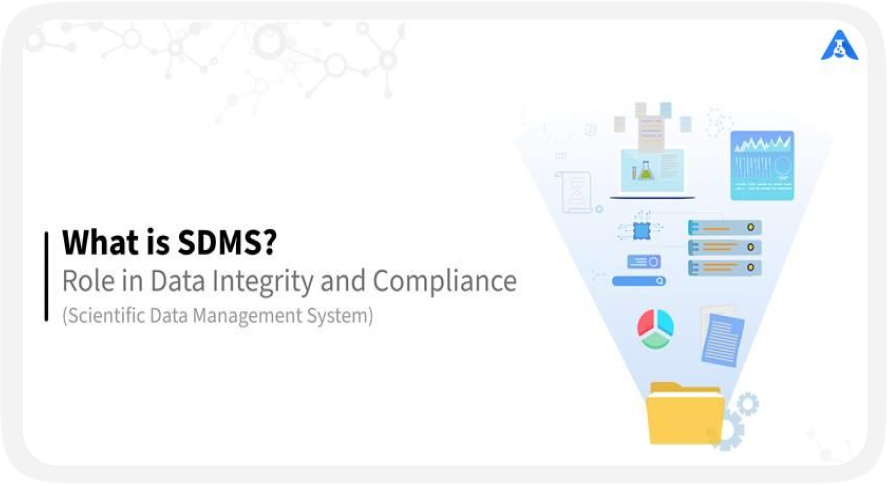
A Scientific Data Management System (SDMS) provides a centralized way to capture, organize, store, and retrieve data generated across experiments and laboratory instruments. This guide explains what SDMS is, how it works, its key benefits, and how it supports data integrity, compliance, and efficient laboratory data management.
What is SDMS?
A Scientific Data Management System (SDMS) is a specialized software solution designed to efficiently capture, store, manage, and retrieve vast volumes of scientific data generated from various laboratory instruments and experiments. Unlike generic data management systems, Scientific Data Management System is tailored for the unique requirements of scientific research, ensuring that data from diverse sources is securely managed and easily accessible for analysis, reporting, and decision–making.
Core Features of Logilab SDMS
Universal Instrument Connectivity
Logilab SDMS connects with laboratory instruments across manufacturers, models, and file formats.
PC-Based Instruments: Automatically captures raw data, metadata, and human-readable outputs such as PDFs.
Standalone Instruments: Captures data through RS232, TCP/IP, and analog ports such as 4–20mA and 0–50V.
Clinical Diagnostics: Supports uni-directional and bi-directional connectivity with clinical IVD analyzers through Interfacer® Middleware.
Chromatography Data Systems (CDS): Connects with CDS platforms through SDKs and REST APIs to capture project, sequence, and run data.
File-Agnostic Processing: Handles proprietary files, PDFs, CSVs, TXT files, images, and other high-volume data formats.
Flexible Scheduling: Supports continuous file monitoring, scheduled data collection, and parallel uploads.
Secure Data Storage and Management
Captured data is securely transferred, organized, and indexed for easy access.
Hybrid Storage: Stores files on secure SFTP or cloud storage while indexing metadata in a centralized SQL database.
Folder Structure Replication: Maintains the source instrument's folder structure to simplify navigation.
DMS Explorer: Provides search, filtering, and logical data separation across multiple storage locations.
Multi-Format Viewer: Enables users to preview formats such as PDF, CSV, TXT, and TIFF directly through a browser.
Version Control: Maintains file histories and supports rollback to previous versions when required.
Metadata, Search, and Data Parsing
Logilab SDMS makes scientific data easier to classify, search, and reuse.
Metadata Tagging: Apply customizable tags and hierarchical templates before or after data capture.
Intelligent Search: Find files using metadata, tags, parameters, and other data attributes.
Data Parsing: Extract structured parameters from raw instrument files and make them available for databases and analytics.
Data Integrity and Regulatory Compliance
Logilab SDMS supports data integrity and audit readiness across the scientific data lifecycle.
Complete Audit Trail: Tracks activities such as uploads, downloads, restores, deletions, errors, scheduler activities, service changes, and communication failures.
Audit Controls: Supports manual audit trails, electronic signatures, audit review, and approval workflows.
ALCOA+ Principles: Supports data integrity requirements around data being Attributable, Legible, Contemporaneous, Original, and Accurate.
CFR Gateway: Helps bring legacy standalone GxP systems under controlled workflows to support 21 CFR Part 11 requirements.
Enterprise Security and Administration
The platform provides controlled access and security features for laboratory data.
Role-Based Access Control (RBAC): Manage permissions at the file, folder, instrument, and user levels.
Active Directory Integration: Supports Windows Active Directory authentication and single sign-on (SSO).
Data Encryption: Protects data in transit and at rest using encryption.
Global Deployment: Provides a browser-accessible, cloud-ready architecture with multilingual and regional time-zone support.
Integration with LIMS, ELN, and ERP
Logilab SDMS connects scientific data with other laboratory and enterprise applications, reducing data silos.
LIMS Integration: Connects with systems such as Qualis LIMS to exchange laboratory data and metadata.
ELN Integration: Integrates with Logilab ELN to connect experimental records with instrument-generated data.
Enterprise Integration: Connects with MES, ERP platforms such as SAP, and other business systems.
REST APIs: Enables secure bidirectional exchange of parsed data and metadata with connected applications.
Who Needs an SDMS
Researchers and Scientists
Academic and industrial researchers use SDMS to store, organize, retrieve, and share experimental and instrument-generated data across projects.
Data Analysts and Bioinformaticians
SDMS provides centralized and structured scientific data that analysts can access for data analysis, computational workflows, and research insights.
Laboratory Teams
Laboratory managers and technicians use SDMS to manage instrument data, improve traceability, and maintain consistent data workflows.
Quality and Regulatory Teams
QA, QC, and regulatory professionals use SDMS to maintain data integrity, support audits and inspections, and manage records required for regulatory activities.
IT and Data Management Teams
IT teams manage SDMS security, access controls, integrations, configuration, and data infrastructure to maintain a secure and reliable data environment.
Clinical and Environmental Researchers
Clinical researchers can manage study-related data and instrument outputs, while environmental scientists can organize data from monitoring instruments, field observations, and analytical systems.
Research Collaborations
Research institutions and collaborative teams can use SDMS to securely share and manage scientific data across departments, locations, and organizations.
Data Integrity & SDMS
Data integrity is essential for reliable, reproducible, and trustworthy scientific research. In laboratories, it means ensuring that data remains accurate, complete, consistent, and traceable throughout its lifecycle, from collection and storage to retrieval and analysis.
A Scientific data management system (SDMS) helps laboratories protect and organize scientific data, including instrument files, assay results, microscopy images, and other research records.
What Is Data Integrity?
Data integrity is commonly guided by the ALCOA principles:
- Attributable: Data can be traced to the person who generated it.
- Legible: Data is clear, readable, and understandable.
- Contemporaneous: Data is recorded when the activity takes place.
- Original: Original records and source data are preserved.
- Accurate: Data correctly reflects what was observed or performed.
Following these principles helps laboratories maintain reliable data and support regulatory and scientific requirements, including 21 CFR Part 11 guidelines for pharmaceuticals, biotechnology, clinical research, medical devices, healthcare, food and beverage, and other regulated industries.
How Logilab SDMS Supports Data Integrity
Logilab SDMS supports data integrity through regulatory compliance, paperless workflows, system integration, and universal instrument connectivity.
Compliance with Regulations
Logilab SDMS supports:
21 CFR Part 11, EU Annex 11, and ALCOA+ requirements for compliant electronic data management.
CFR Gateway: A compliance solution that brings non-compliant laboratory systems into GxP compliance and supports 21 CFR Part 11 alignment.
Going Paperless
Logilab SDMS enables paperless laboratory workflows by:
- Automating instrument data capture and reducing manual errors.
- Maintaining electronic records and audit trails for traceability.
- Centralizing scientific data for easy retrieval and access.
Integration with ELN & LIMS
Logilab SDMS integrates with Qualis LIMS and Logilab ELN through REST APIs to:
- Enable bidirectional exchange of parsed data and metadata.
- Connect instrument data with laboratory workflows and records.
- Improve data consistency and traceability.
Universal Instrument Connectivity
Logilab SDMS supports:
- PC-based and standalone instruments via RS232, TCP/IP, and analog ports.
- Clinical IVD analyzers through Interfacer Middleware.
- Chromatography data systems through SDKs and REST APIs.
Conclusion
Implementing Logilab SDMS helps laboratories strengthen data integrity, regulatory compliance, and scientific data management while improving operational efficiency. With integrations across LIMS and ELN, universal instrument connectivity, and pre-configured IQ/OQ/PQ validation templates, Logilab SDMS can speed up validation for pharmaceutical and clinical deployments. As laboratories move toward connected, paperless workflows, a Scientific Data Management System provides a reliable foundation for managing, protecting, and accessing scientific data throughout its lifecycle.
Stop chasing data across disconnected instruments. See how Logilab SDMS becomes your lab's single source of truth. Book a free personalized SDMS demo today!
- What is SDMS?
- Core Features of Logilab SDMS
- Who Needs an SDMS
- Data Integrity & SDMS
- How Logilab SDMS Supports Data Integrity
- Conclusion

Related articles

Data Traceability in Laboratories: Why It Matters
What Is Laboratory Traceability Laboratory traceability is the ability to trace the complete history of a s...

Clinical Research Data Management Best Practices
Managing Clinical Data Clinical research produces an immense and steadily growing volume of data across eve...

Managing Clinical Trial Samples with LIMS
Introduction: From Patient to Proof Clinical trial sample management is far more complex than routine labor...
 Contact Us