
Managing Clinical Trial Samples with LIMS
 Request a Demo
 Download Brochure
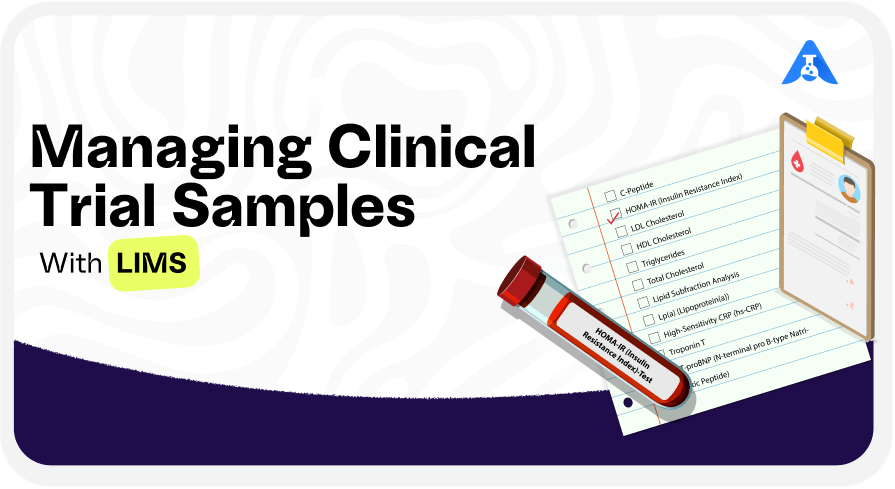
Introduction: From Patient to Proof
Clinical trial sample management is far more complex than routine laboratory sample tracking because every sample represents a critical milestone in a patient's treatment journey and a source of evidence for regulatory decision-making. A blood draw in a Phase II oncology study, a urine sample from a nephrology trial, or a biopsy collected during a rare disease program must remain traceable from the investigator site to the testing laboratory and ultimately to the regulatory submission. Throughout this process, laboratories must maintain complete chain of custody and comply with regulations such as ICH E6 Good Clinical Practice (GCP), FDA 21 CFR Part 11, and EudraLex Annex 11.
Managing clinical trial samples with paper records, spreadsheets, or disconnected systems increases the risk of lost traceability, documentation gaps, and data integrity issues that can jeopardize an entire study. A Clinical Trial Sample Management Laboratory Information Management System (LIMS) eliminates these risks by providing sample tracking, automated chain of custody, protocol-driven workflows, inventory management, laboratory integration, and regulatory compliance.
How LIMS helps Clinical Trial Sample Management
Complete Sample Traceability
One of the biggest challenges in clinical trial sample management is maintaining complete sample traceability throughout the entire study. Clinical trial samples are collected across multiple investigator sites, divided into aliquots, transferred between laboratories, tested, and archived for future analysis. Every movement must be documented to establish an uninterrupted chain of custody that meets regulatory requirements.
Agaram's Cloud-based Qualis LIMS provides end-to-end clinical trial sample tracking within a single integrated platform. Every sample is registered with key metadata, including subject ID, study visit, collection details, sample type, storage conditions, and receipt status. The system generates unique barcodes, tracks parent and aliquot relationships, records every storage location, transfer, retrieval, and testing event, and automatically captures user identities and timestamps in a secure audit trail. When sponsors or regulatory inspectors request a complete chain of custody for any clinical trial sample, Qualis LIMS can generate a comprehensive traceability record within seconds, ensuring data integrity, regulatory compliance, and inspection readiness.
Biobank Management and Long-Term Storage
Clinical trial samples are often retained for years after a study is completed to support biomarker research, companion diagnostics, post-market studies, and regulatory retention requirements. Managing thousands of stored specimens across multiple freezers and storage locations requires complete visibility into sample inventory, storage conditions, and retrieval history. Without a dedicated Clinical Trial LIMS software, maintaining long-term sample traceability and regulatory compliance becomes increasingly difficult.
Clinical Trial LIMS provides comprehensive biorepository management by digitally mapping every storage location, from facility and room to freezer, rack, shelf, box, and individual position. Barcode-based tracking enables rapid sample retrieval while maintaining a complete chain of custody. The system monitors available storage capacity, generates automated alerts for sample expiry or scheduled disposal, and records every storage, retrieval, and movement event with authenticated user details and timestamps.
Environmental Monitoring
Maintaining sample integrity across a clinical trial depends as much on storage conditions as it does on collection protocols. Even a brief deviation in freezer temperature can compromise biological specimens and put the validity of downstream data at risk. Qualis LIMS integrates with environmental monitoring systems to continuously capture temperature and humidity data from storage units, ensuring that conditions are tracked without gaps or manual intervention. When a storage excursion is detected, the system flags the event in real time and automatically links the affected samples to a documented investigation, giving quality teams the context they need to assess impact and take corrective action. Every deviation, response, and outcome is recorded within the system, creating a complete and timestamped audit trail that supports regulatory review. This level of traceability helps clinical research sites demonstrate compliance with ALCOA+ principles and GCP requirements while significantly reducing the risk of compromised samples going undetected or undocumented.
Multi-Site Trial Coordination
Global clinical trials rarely analyze samples at a single laboratory. Central laboratories handle primary efficacy endpoints, local laboratories at investigator sites handle safety monitoring parameters, specialty laboratories perform biomarker and pharmacogenomic analyses, and reference laboratories provide method standardization and comparability data. Each laboratory must work from the same sample registration framework, follow protocol-defined methods, and contribute results to a unified clinical trial dataset.
Qualis LIMS multi-site architecture enables all participating laboratories to operate on a single integrated platform with a shared protocol data environment and controlled, role-based access to site-specific operations. Each laboratory only views its assigned samples and testing responsibilities, while the study sponsor has real-time visibility into the complete cross-site dataset. Results generated from different laboratories are automatically consolidated within the same subject and visit record, eliminating the need for manual data aggregation. Any discrepancies between site-specific, central laboratory, or specialty laboratory results for the same sample are automatically identified and flagged for protocol-defined review and adjudication, ensuring consistent data quality and streamlined clinical trial execution at global scale.
Subject Blinding and Sample Integrity
Maintaining blinding is essential in clinical trials to protect study integrity and ensure unbiased results. Errors in sample labelling, subject identification, or data access can lead to accidental unblinding, compromising treatment allocation and potentially affecting the validity of the trial. A Clinical Trial LIMS helps prevent these risks by enforcing standardized sample identification, secure access controls, and protocol-specific workflows.
Clinical Trial LIMS supports blinded study management through pseudonymized subject identifiers that separate patient identity from sample identity, helping organizations comply with Good Clinical Practice (GCP), GDPR, HIPAA, and other data privacy requirements. Configurable sample registration templates enforce protocol-defined labelling conventions, while role-based access controls restrict treatment allocation information to authorized personnel only. Every access, modification, and unblinding event is automatically recorded in a secure audit trail, providing complete traceability for regulatory inspections and ensuring the integrity of blinded and adaptive clinical trial designs.
GCP Compliance and Audit Readiness
Clinical trial sample management is subject to strict regulatory oversight, requiring laboratories to demonstrate complete sample traceability, data integrity, and compliance during FDA inspections, EMA GCP audits, and sponsor reviews. Inspectors must be able to verify every stage of the sample lifecycle, including collection, transportation, storage, testing, result approval, and chain of custody. A Clinical Trial LIMS provides a centralized, inspection-ready record that ensures every action is documented and easily retrievable.
Clinical Trial LIMS helps pharmaceutical companies, biotechnology organizations, and clinical research organizations (CROs) maintain regulatory compliance by automatically recording every sample transaction in a secure, tamper-proof audit trail with authenticated user identities, timestamps, and electronic signatures that support FDA 21 CFR Part 11, EudraLex Annex 11, and GCP requirements. Qualis LIMS also integrates with other clinical platforms through REST APIs, enabling automated data exchange without manual entry. By synchronizing subject visit information directly into the LIMS, laboratories and clinical research organizations reduce transcription errors, improve sample traceability, and ensure every specimen is accurately linked to the correct subject, visit, and clinical study protocol.
Result Management and Regulatory Submission
The analytical data generated from clinical trial samples forms a critical part of the regulatory submission for new drugs, biologics, and medical therapies. Regulatory agencies expect every reported result to be fully traceable to its original raw data, validated analytical method, and authorized analyst. Without complete data traceability, the reliability of laboratory results and the integrity of the clinical trial may be questioned during regulatory review.
Logilab SDMS works seamlessly with Clinical Trial LIMS to automatically capture and securely archive raw instrument data generated during clinical sample analysis, including HPLC chromatograms, LC-MS and GC-MS outputs, flow cytometry files, bioassay reader results, and other analytical data. Each raw data file can be permanently linked to the corresponding sample record in Qualis LIMS, creating a complete digital record from sample collection to final result. Every analytical result submitted to a regulatory authority as part of a clinical trial data package is backed by its original, unmodified raw data file, satisfying the ALCOA+ original data requirement and the FDA's expectation under 21 CFR Part 11 that electronic records used in regulatory submissions are complete and authentic.
Looking for SDMS-compatible instruments? Browse our list.
Clinical Sample Documentation
Clinical trial sample management depends on complete, controlled documentation for every sample, including protocols, SOPs, chain of custody records, consent forms, stability studies, and disposal records. Without centralized control, documentation gaps and version errors can create serious compliance risks during audits and inspections. Agaram’s Qualis DMS provides a single version-controlled repository with structured review and approval workflows, ensuring only current authorized documents are used across all sites while maintaining full version history and traceability. Role-based access, electronic signatures, and audit trails support compliance with 21 CFR Part 11 and EU Annex 11 and ensure all sample-related documentation is instantly retrievable and audit ready during inspections.
The Case for LIMS in Clinical Trial Sample Management
Clinical trial sample management faces growing challenges in traceability, data integrity, scalability, audit readiness, and regulatory compliance, making a LIMS essential for controlled and reliable operations.
Sample Traceability Gaps: Clinical trial teams often struggle to maintain a complete and verifiable record of where a sample has been, who handled it, and under what conditions it was stored or transported. Missing timestamps, inconsistent labelling, and incomplete custody documentation create serious compliance risks during audits. A Clinical Trial Sample Management LIMS closes these gaps by enforcing end-to-end sample traceability with automated chain of custody tracking at every stage.
Data Fragmentation Issues: Clinical trial sample data is frequently spread across spreadsheets, local databases, and disconnected laboratory systems. This fragmentation leads to duplicate records, inconsistent identifiers, and delays in consolidating results across sites. A LIMS centralizes all sample data into a single controlled platform, ensuring consistent sample identity and a unified source of truth across the entire study.
Scale Complexity: Modern clinical trials generate large volumes of samples across global sites, including decentralized collection models, biomarker studies, and multi-site laboratory testing. Manual tracking methods cannot scale to this level of operational complexity. A Cloud-based LIMS automates sample registration, tracking, workflow execution, and reporting to support high-throughput clinical trial environments without loss of control.
Audit Readiness: Regulatory inspections require instant access to complete sample histories, including collection details, transport conditions, storage history, analytical methods, and result approvals. Manual systems make this process slow and error prone. A Laboratory Information Management System (LIMS) software maintains a continuously updated audit trail that enables real-time reconstruction of any sample’s full lifecycle for FDA, EMA, or GCP inspections.
Compliance Infrastructure: Clinical trial execution requires a validated and controlled digital system that supports protocol compliance, standardized workflows, and secure data management. A Clinical Trial Sample Management LIMS provides this infrastructure by integrating sample tracking, laboratory operations, audit trails, and system interoperability into one compliant platform.
Conclusion
Clinical trial samples form the foundation of the scientific evidence used to evaluate the safety and efficacy of new therapies. Because these samples directly influence regulatory decisions and patient outcomes, the systems that manage them must ensure uncompromising traceability, data integrity, and compliance throughout the entire study lifecycle. Clinical trial sample management LIMS software is not optional infrastructure for GCP-regulated laboratories or for achieving a paperless lab environment. It is the essential operational and compliance backbone that ensures reliable clinical trial execution and trustworthy regulatory submissions.
To see how Clinical Trial LIMS can streamline sample management, strengthen compliance, and improve end-to-end traceability, schedule a personalized LIMS software demo today!
- Introduction: From Patient to Proof
- How LIMS helps Clinical Trial Sample Management
- The Case for LIMS in Clinical Trial Sample Management
- Conclusion
Related articles

Data Traceability in Laboratories: Why It Matters
What Is Laboratory Traceability Laboratory traceability is the ability to trace the complete history of a s...

Clinical Research Data Management Best Practices
Managing Clinical Data Clinical research produces an immense and steadily growing volume of data across eve...

Laboratory Informatics for Water Testing Laboratories
Introduction: What’s in Your Water? Imagine this. A water quality analyst finishes testing a batch of munic...
 Contact Us