How SDMS Supports ALCOA+ Data Integrity Principles
 Request a Demo
 Download Brochure
Introduction: Data Integrity in Regulated Industries
Data integrity is the backbone of trust in regulated science. Whether you are running a GMP pharmaceutical facility, a contract research organisation, or a clinical diagnostics lab, your data must hold up to the highest scrutiny. That is where ALCOA+ compliance becomes non-negotiable, and where a purpose-built Scientific Data Management System (SDMS) proves its true worth.
SDMS data integrity capabilities map directly to every ALCOA+ principle, and organisations that invest in the right SDMS platform gain a decisive competitive edge during audits, inspections, and beyond.
What Is SDMS?
A Scientific Data Management System (SDMS) is a software platform designed to capture, organise, store, retrieve, and archive scientific data and documents generated across laboratory instruments, workflows, and enterprise systems. Unlike generic document management tools, an SDMS is purpose-built for regulated lab environments that involve integrating with instruments, compliant ELN and laboratory Information Management System (LIMS) platforms, to create a unified, secure data repository.
Modern SDMS platforms serve as the connective tissue between raw instrument output and enterprise-level compliance. They automate data capture, enforce metadata standards, maintain unbroken audit trails, and ensure that every data point is handled in alignment with ALCOA+ data integrity requirements.
Agaram Technologies' Logilab SDMS is engineered precisely for this purpose: delivering end-to-end scientific data lifecycle management with native ALCOA+ compliance.
Download the SDMS Brochure.
What Is ALCOA+ and Why Does It Define Modern Data Integrity?
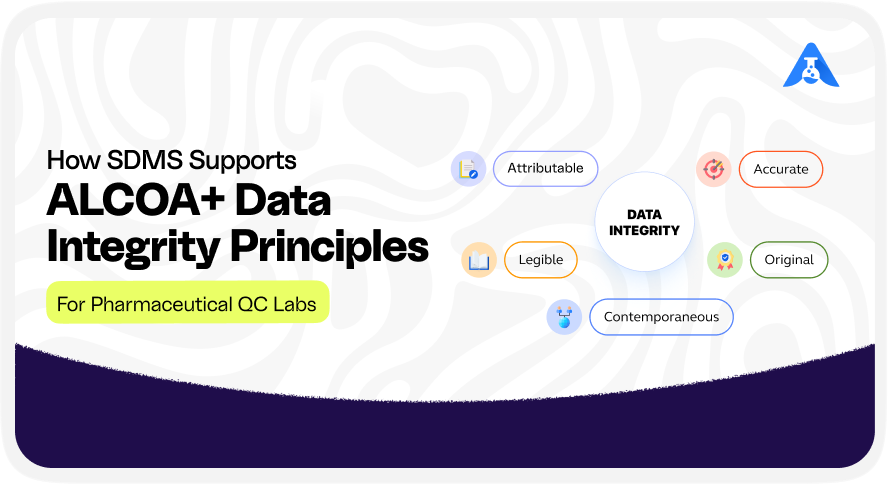
ALCOA+ is the gold standard framework for data integrity in regulated environments, endorsed by the FDA, EMA, WHO and MHRA. The acronym stands for:
A: Attributable
L: Legible
C: Contemporaneous
O: Original
A: Accurate
The "+" extends these with four additional principles: Complete, Consistent, Enduring, and Available. Together, they define what it means for raw data, metadata, and audit trails to be trustworthy, traceable, and inspection ready.
ALCOA+ compliance is foundational to 21 CFR Part 11 compliance, EU Annex 11 readiness, and overall Good Documentation Practice (GDP).
How SDMS Satisfies Each ALCOA+ Data Integrity Principle
Attributable: Who Did What, and When?
A compliant SDMS software enforces user-level authentication with role-based access control, ensuring every data entry, modification, approval, and deletion is tied to a unique, verified user identity. Electronic signatures compliant with 21 CFR Part 11 and EU Annex 11 create an immutable link between a person and an action. Audit trail management in an SDMS captures usernames, timestamps, IP addresses, and reasons for change, all automatically. No manual log, no paper trail, no ambiguity.
Legible: Is the Data Readable Now and in the Future?
Data captured in a scientific data management system (SDMS) is rendered in standardised, human-readable formats with rich metadata tagging, ensuring that records remain legible across their entire retention lifecycle, whether that is 5 years or 30 years. Full-text search and intelligent indexing mean that no record is ever buried or unreadable.
Contemporaneous; Was It Recorded in Real Time?
SDMS eliminates backdated recording risk through automated, real-time data capture directly from instruments and connected systems.
When an HPLC run completes, the raw data file is captured automatically. When an analyst reviews a result, the SDMS logs the timestamp of that review. There is no manual intervention, no opportunity to alter when a record was created. This real-time data acquisition is central to contemporaneous documentation and is fully auditable.
Wondering if your instrument is SDMS compatible? Check our list.
Original: Is This the True Source Record?
An SDMS captures data directly at the point of origin, i.e., from instrument integrations, API connections, or secure automated file monitoring, creating a verified original record that is stored immutably.
Hash verification and digital fingerprinting ensure that the file stored in the SDMS is byte-identical to what the instrument generated. Any attempt to alter the original is detected and logged. This is what separates a true SDMS data integrity framework from a simple file server or shared drive.
Accurate: Does the Data Reflect Reality?
An SDMS eliminates manual transcription entirely through direct instrument integration and structured data capture pipelines.
Data validation rules, range checks, and automated plausibility checks built into the SDMS workflow flag anomalies at the point of capture. When combined with electronic workflows for review and approval, the SDMS creates a systematic defence against inaccuracy that no paper-based system can match.
Complete: Is the Full Picture Captured?
A scientific data management system (SDMS) enforces completeness by capturing not just primary data but all associated metadata: instrument parameters, method versions, sample IDs, environmental conditions, and sequence information. Configurable mandatory fields ensure that no record can be filed without required data elements. Version control on methods and templates ensures that the complete context of an experiment is preserved alongside its results.
Consistent: Does the Data Follow a Logical Timeline?
SDMS platforms use synchronised, server-side timestamps and cross-system data validation to ensure internal consistency across all records.
Integration with LIMS and ELN platforms means that a sample registered in LIMS must exist before a result can be recorded in the SDMS, thereby enforcing logical sequence and making inconsistencies structurally impossible.
Enduring: Will the Data Last?
SDMS provides long-term archival storage with redundancy, scheduled integrity checks, and disaster recovery capabilities. Records stored in the SDMS are protected against hardware failure, ransomware, and accidental deletion through versioned backups and hierarchical storage management.
Retention policies enforced at the system level ensure that records are kept for the required period and cannot be deleted prematurely without an authorised workflow that itself generates an audit trail.
Available: Can It Be Retrieved on Demand?
Scientific data management system (SDMS) platforms provide rapid, controlled retrieval through indexed search, metadata filters, and role-based access. Records are available 24/7, whether the original instrument operator is still at the company or not.
Cloud-based and hybrid SDMS deployments extend availability further, ensuring that data is accessible from global sites and remote reviewers without compromising security or audit trail integrity.
Why SDMS Data Integrity Is a Competitive Advantage
When data infrastructure is built on a robust SDMS, the operational and strategic benefits compound well beyond audit readiness.
- Faster regulatory submissions: When data is captured, organised, and compliant from the start, teams can compile regulatory dossiers and respond to agency queries in days rather than weeks.
- Lower compliance costs: Manual data handling, paper-based audit trails, and retrospective remediation are expensive. An SDMS reduces these burdens by embedding compliance directly into everyday workflows.
- Greater audit readiness: With a purpose-built SDMS, organisations are better prepared for unannounced inspections because records are traceable, actions are logged, and data can be retrieved quickly.
Agaram Technologies has designed Logilab SDMS to deliver these competitive advantages as standard. Built with the GxP laboratory in mind, it integrates natively with Logilab ELN, Qualis LIMS, and Qualis DMS to create a seamless, ALCOA+ compliant data ecosystem from sample to submission.
Conclusion
ALCOA+ Compliance Starts with the Right SDMS
The ALCOA+ framework gives regulated laboratories a clear standard to meet, and a modern scientific data management system (SDMS) gives them the technical architecture to meet it reliably, repeatably, and at scale.
From pharmaceutical manufacturers navigating 21 CFR Part 11 to clinical diagnostics labs operating under ISO 15189, from CROs managing multi-sponsor study data to chemical manufacturers, SDMS data integrity is the common thread that ties compliant operations together.
Ready to see how Logilab SDMS maps to your ALCOA+ compliance requirements? Connect with our team for a personalised SDMS demo for a GLP compliant laboratory.
- Introduction: Data Integrity in Regulated Industries
- What Is SDMS?
- What Is ALCOA+ and Why Does It Define Modern Data Integrity?
- How SDMS Satisfies Each ALCOA+ Data Integrity Principle
- Why SDMS Data Integrity Is a Competitive Advantage
- Conclusion
Related articles

Data Traceability in Laboratories: Why It Matters
What Is Laboratory Traceability Laboratory traceability is the ability to trace the complete history of a s...

Clinical Research Data Management Best Practices
Managing Clinical Data Clinical research produces an immense and steadily growing volume of data across eve...

Managing Clinical Trial Samples with LIMS
Introduction: From Patient to Proof Clinical trial sample management is far more complex than routine labor...
 Contact Us