
Navigating GxP Compliance: The Transformative Impact of Qualis LIMS on Industry Standards
 Request a Demo
 Download Brochure
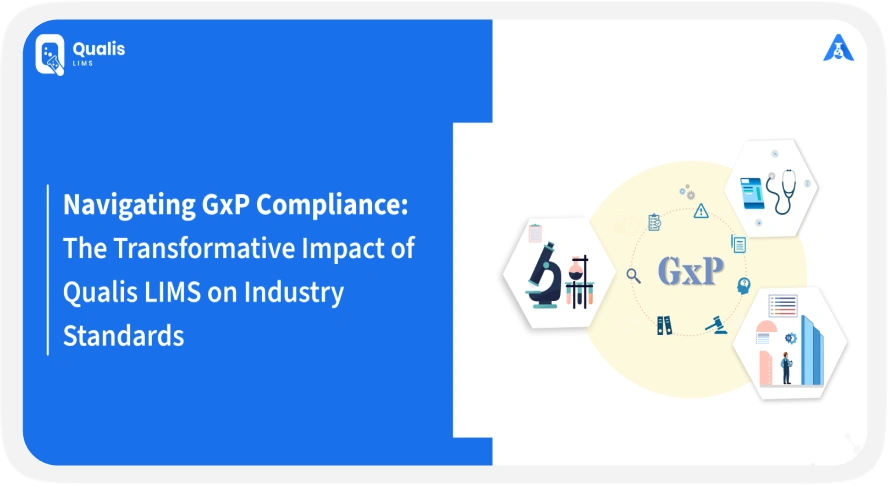
GxP refers to a collection of quality guidelines and regulations that ensure that bio/pharma products are safe, meet their intended use, and adhere to quality processes during manufacturing, control, storage, and distribution.
The “G” stands for “Good” and the “P” stands for “Practice”.
The ‘x’ in GxP can be substituted for various terms depending on the application, such as manufacturing, clinical, laboratory, etc.
But how are these GxP practices applied to the various industries and why are they so important?
What solutions can be implemented to ensure that these practices are strictly adhered to?
Let’s find out.
GxP Classifications
Good Manufacturing Practices (GMP)
Purpose: Ensure pharmaceutical and medical products are consistently manufactured and controlled according to established quality standards.
Scope: Covers manufacturing, packaging, labeling, testing, and storage of pharmaceuticals, medical devices, and food products.
Key Elements: Quality assurance, quality control, validated manufacturing processes, equipment qualification, documentation, personnel training, and facility management.
Good Clinical Practices (GCP)
Purpose: Ensure clinical trials are conducted ethically while generating accurate, reliable, and scientifically valid data.
Scope: Applies to all clinical studies involving human participants, from trial design to reporting.
Key Elements: Informed consent, participant safety, protocol compliance, ethics committee oversight, monitoring, data management, and accurate reporting.
Good Laboratory Practices (GLP)
Purpose: Ensure the consistency, reliability, and integrity of non-clinical laboratory studies used to evaluate product safety.
Scope: Covers non-clinical research, including toxicology, environmental, chemical, and safety studies before human clinical trials.
Key Elements: Standard operating procedures (SOPs), study planning, quality assurance, equipment calibration, data recording, archiving, and final reporting.
Good Distribution Practices (GDP)
Purpose: Maintain the quality and integrity of medicines throughout the supply chain until they reach healthcare providers or patients.
Scope: Applies to the procurement, storage, transportation, handling, and wholesale distribution of medicinal products.
Key Elements: Temperature-controlled storage, transportation monitoring, traceability, inventory management, secure handling, documentation, and supplier qualification.
Good Documentation Practices (GDocP)
Purpose: Ensure all paper and electronic records are accurate, complete, consistent, and readily available for regulatory review.
Scope: Applies across all GxP-regulated activities, including research, manufacturing, quality control, and distribution.
Key Elements: Data integrity, audit trails, version control, document security, record retention, controlled access, and accurate, timely documentation.
Good Pharmacovigilance Practices (GVP)
Purpose: Protect patient safety by continuously monitoring the risks and benefits of medicines after they are approved for use.
Scope: Covers post-marketing surveillance, adverse event reporting, risk management, and ongoing safety evaluations.
Key Elements: Adverse event collection, signal detection, benefit-risk assessment, safety reporting, regulatory compliance, and continuous monitoring of marketed products.
Why is following GxP practices non-negotiable?
The adherence to Good Practices (GxP) standards is critical and provides numerous benefits across various industries, especially those involved in the production, control, and distribution of pharmaceuticals, biotechnology products, medical devices, and food. The implementation of GxP has profound impacts on the product’s quality, safety, and efficacy, which are essential for protecting public health and maintaining consumer trust.
The following is a breakdown of why following GxP practices is both critical and beneficial:
Ensuring Quality and Safety
Purpose: GxP ensures that products are consistently researched, developed, manufactured, tested, and controlled according to predefined quality standards and intended-use requirements.
Benefit: Helps minimize product defects, contamination risks, and process errors, ensuring safe, effective, and high-quality products for patients and consumers.
Maintaining Regulatory Compliance
Purpose: GxP provides a framework for organizations to meet regulatory requirements established by authorities such as the U.S. FDA, European Medicines Agency (EMA), and other global health agencies.
Benefit: Ensures smoother regulatory approvals, reduces the risk of compliance violations, product recalls, and legal penalties, while protecting organizational reputation.
Supporting Research and Innovation
Purpose: GxP guidelines create a structured approach for research, development, testing, and commercialization of new pharmaceutical, biotechnology, and healthcare products.
Benefit: Enables organizations to introduce innovative products while maintaining scientific accuracy, regulatory compliance, and consistent quality throughout the development lifecycle.
Building Consumer Trust and Confidence
Purpose: Following GxP standards demonstrates an organization's commitment to maintaining product quality, safety, and effectiveness.
Benefit: Builds confidence among patients, healthcare professionals, and customers, strengthening brand reputation and long-term market success.
Enabling Global Market Expansion
Purpose: Compliance with globally recognized GxP standards helps organizations align their processes with international quality and regulatory expectations.
Benefit: Makes it easier to enter new markets, meet regional regulatory requirements, and expand product availability across different countries.
Improving Operational Consistency and Efficiency
Purpose: GxP establishes standardized processes, documentation practices, and quality management systems across research, manufacturing, and distribution operations.
Benefit: Improves workflow efficiency, reduces process variations, simplifies employee training, and ensures consistent product quality across multiple sites.
Enhancing Risk Management
Purpose: GxP promotes proactive risk identification, assessment, and control throughout the entire product lifecycle, from research and development to commercialization.
Benefit: Helps prevent quality failures, compliance issues, and operational disruptions while improving product reliability and supply continuity.
Maintaining Data Integrity and Traceability
Purpose: Through Good Documentation Practices (GDocP) and other GxP requirements, organizations ensure that data is accurate, complete, consistent, secure, and traceable.
Benefit: Reliable data supports regulatory submissions, audits, scientific decision-making, and compliance with data integrity principles such as ALCOA+.
Industries Impacted
Pharmaceuticals and Biotechnology
The pharmaceutical and biotechnology industries are among the most heavily impacted by GxP regulations, as they involve complex research, development, manufacturing, and distribution processes. Practices such as Good Manufacturing Practices (GMP), Good Laboratory Practices (GLP), and Good Clinical Practices (GCP) ensure that drugs and biologics are developed safely, tested accurately, manufactured consistently, and supported by reliable data. GxP compliance helps these organizations maintain product quality, patient safety, and regulatory approval throughout the product lifecycle.
Medical Devices
The medical device industry relies on GxP principles, particularly GMP and GCP, to ensure devices are designed, tested, manufactured, and monitored according to safety and performance standards. Compliance supports effective quality management systems, accurate documentation, risk assessment, clinical evaluation, and post-market monitoring to ensure devices meet regulatory expectations and protect patient health.
Food Production and Consumer Health Products
The food and consumer health industries are primarily influenced by GMP and GDP guidelines to maintain product safety, quality, and traceability. These practices help organizations control manufacturing processes, prevent contamination, manage supply chains, and ensure products are stored and distributed under appropriate conditions.
Research Organizations and Contract Laboratories
Research institutions, contract research organizations (CROs), and testing laboratories follow GxP standards such as GLP and GDocP to maintain reliable study results, accurate records, and regulatory compliance. These practices ensure that research data is trustworthy, reproducible, and suitable for regulatory submissions.
What is LIMS?
A laboratory information management system, or LIMS, is a lab information system software designed to streamline the management of laboratory data and operations. LIMS is utilized in various scientific and industrial settings where laboratories need to manage large volumes of data, such as in pharmaceuticals, healthcare, environmental science, manufacturing, and research institutions.
Many organizations looking for research lab management software choose LIMS platforms because general project management tools cannot effectively manage sample tracking, instrument integration, or regulatory audit requirements.Main features of a modern LIMS typically include sample tracking, data management, workflow automation, instrument integration, quality control, and regulatory compliance. By centralizing and automating these processes, LIMS helps laboratories improve efficiency, accuracy, and productivity in their operations. Additionally, LIMS enables better data organization, retrieval, and analysis, facilitating decision-making processes within the laboratory setting.
Qualis LIMS Overview
Agaram Technologies’ Qualis LIMS has been designed to digitally transform laboratories to perform their tasks in an automated and paper-less manner, and more importantly enable them to fulfill regulatory compliance requirements as well as adhere to industry standards.
It is used by laboratories conducting tests/experiments and research in any industrial, commercial, and analytical testing of samples. It provides a structural method to document laboratory investigation results in an automated and paper-less manner besides fulfilling various regulatory compliance and standard requirements. Qualis LIMS is also available as a cloud-based LIMS software deployment, which lets labs scale usage as sample volumes grow without managing additional on-site infrastructure.
How Qualis LIMS Supports GxP Compliance
Qualis LIMS (Laboratory Information Management System) plays a significant role in helping laboratories and manufacturing facilities adhere to GxP compliance requirements.
Below is a detailed explanation of how Qualis LIMS facilitates GxP compliance across several critical aspects:
Data Integrity
Qualis LIMS ensures data integrity through several mechanisms.
Audit Trails: Every data entry, modification, and deletion is logged with timestamps and user details, making it easy to track who did what and when.
Electronic Signatures: Data entries and changes require electronic signatures, further ensuring that data is accurately recorded and authenticated.
Data Validation: Built-in checks verify data for accuracy and completeness upon entry, preventing incorrect data from being saved.
Traceability
Traceability is critical in regulated environments to track the history of a sample or batch of products.
Sample Tracking: Qualis LIMS assigns unique identifiers to samples, allowing users to track the entire lifecycle of a sample, from receipt through disposal, using the same lab sample tracking software functionality that underpins chain of custody records.
Chain of Custody: Maintains a detailed record of who handled each sample and when, providing a clear trace of custody which is essential for compliance.
Standardization and Consistency
Standardizing processes is key to GxP compliance as it ensures consistency of operational processes and results.
Standard Operating Procedures (SOPs): Qualis LIMS can be configured to enforce SOPs, ensuring that all laboratory processes are carried out in a consistent, predefined manner.
Method Execution: Standard methods can be embedded into workflows, ensuring that each step is performed according to the prescribed standards. For organizations managing nonconformances or corrective actions tied to standardization failures, Qualis QMS extends this further by tracking quality events back to the exact SOP, sample, and instrument involved, closing the loop between standardization and quality management.
Automation and Reduction of Human Errors
Automation significantly reduces the risk of human errors.
Automated Data Entry: Interfaces with laboratory instruments for direct data capture, eliminating manual data entry errors.
Workflow Automation: Automates workflows to ensure steps are performed in the correct sequence, thus reducing the chance of procedural errors. Interfacer helps connect older laboratory instruments that lack digital output, allowing them to automatically send data into the same system and reducing the need for manual data entry.
Quality Control and Quality Assurance
Quality is a cornerstone in GxP-regulated environments.
Control Samples and Calibration: Automates the inclusion of control samples and calibration checks within test runs to ensure ongoing reliability of results.
Review and Approval Processes: Configurable review and approval workflows ensure that data is checked and verified at critical stages before final decisions are made.
Regulatory Compliance and Regulatory Reporting
Meeting regulatory requirements is integral in regulated industries.
Compliance Features: Qualis LIMS supports regulatory requirements such as FDA 21 CFR Part 11 for electronic records. For older instruments or systems that are not Part 11 compliant, CFR Gateway adds secure authentication and data protection features, helping organizations achieve compliance without replacing existing equipment.
Reporting Tools: Generates compliant reports for regulatory submissions, audits, and inspections quickly and reliably.
Security and Access Control
Data security is vital when handling sensitive lab data.
User Access Levels: Users are given access based on their role, ensuring they can only access data and functionalities relevant to their responsibilities.
Data Encryption: Ensures that stored data is encrypted, protecting sensitive information from unauthorized access.
Integration with Other Systems
Integration capabilities enhance efficiency and data coherence:
ERP Systems: Can be integrated with Enterprise Resource Planning (ERP) systems for a holistic view of operations.
Instrument Integration: Directly connects with laboratory instruments for seamless data transfer, reducing delays and errors associated with manual data handling. For labs running experiments alongside sample testing, Logilab ELN integration extends this same connected approach to research data. Logilab SDMS can also sit alongside Qualis LIMS to manage raw instrument output files specifically, giving labs a documented, GDocP-aligned record of every file an instrument produces, not just the parsed results that make it into the LIMS.
By facilitating these functions, Qualis LIMS not only helps laboratories adhere to regulatory requirements but also enhances their operational efficiencies, thereby supporting the overall quality and reliability of their outputs
Conclusion
Qualis LIMS (Laboratory Information Management System) plays a critical role in helping organizations achieve and maintain GxP compliance by streamlining laboratory workflows, improving data integrity, and ensuring regulatory compliance across industries such as pharmaceuticals, biotechnology, medical devices, and food production. Organizations comparing LIMS software providers often find that the key differentiator is not just individual features, but how effectively a platform integrates compliance management, sample tracking, instrument connectivity, reporting, audit trails, and workflow automation within a single, reliable system.
By supporting essential GxP practices, including Good Manufacturing Practices (GMP), Good Laboratory Practices (GLP), Good Documentation Practices (GDocP), and other regulatory requirements, Qualis LIMS helps laboratories standardize processes, reduce manual errors, and maintain complete traceability of laboratory data. With features that support secure data management, automated workflows, electronic records, and regulatory-ready reporting, Qualis LIMS enables organizations to improve operational efficiency while staying prepared for audits and changing compliance expectations. Its scalable and adaptable architecture allows laboratories to meet current requirements while supporting future growth and evolving industry standards.
Still spending too much time preparing for audits across disconnected systems? Schedule a personalized LIMS demo to see how modern LIMS solutions streamline workflows, improve data integrity, and support audit-ready compliance.
- GxP Classifications
- Why is following GxP practices non-negotiable?
- Industries Impacted
- What is LIMS?
- Qualis LIMS Overview
- How Qualis LIMS Supports GxP Compliance
- Conclusion
Related articles

Logilab ELN vs. Logilab ELN Lite: Finding the Right Fit for Your Lab
In today’s rapidly evolving research environment, managing and securing experimental data is more critical...

How LIMS Software Helps Achieve FDA 21 CFR Part 11 Compliance
In the intricate landscape of laboratory operations, adherence to stringent regulatory standards is crucial...

How SDMS Centralizes Scientific Data Across Laboratories
Introduction Managing and securing research data effectively is more crucial than ever in today’s data-inte...
 Contact Us