
How LIMS Software Helps Achieve FDA 21 CFR Part 11 Compliance
 Request a Demo
 Download Brochure
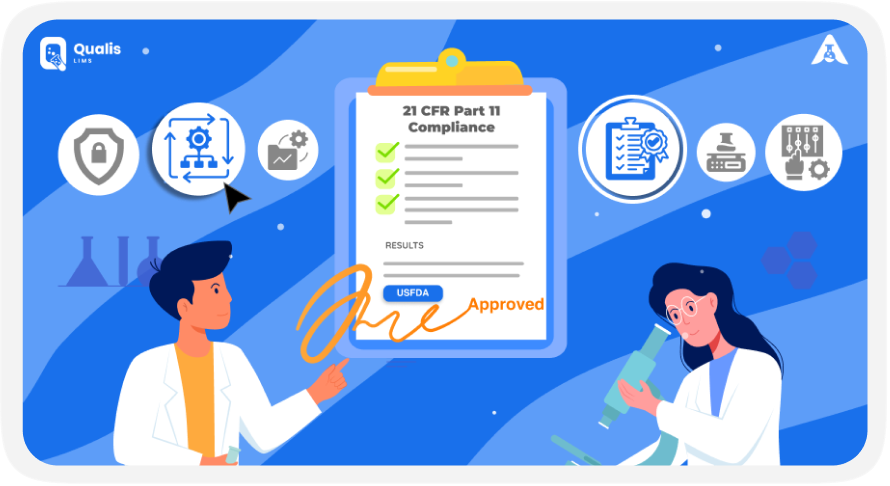
In the intricate landscape of laboratory operations, adherence to stringent regulatory standards is crucial. Among these, 21 CFR Part 11, issued by the U.S. Food and Drug Administration (FDA), plays a pivotal role. This regulation establishes the criteria under which electronic records and electronic signatures are considered trustworthy, reliable, and equivalent to paper records. Let’s get to know how Qualis LIMS (Laboratory Information Management System) enables laboratories to comply with these regulations, ensuring the integrity of electronic data and bolstering operational efficiencies.
About 21 CFR Part 11
21 CFR Part 11, introduced by the FDA in 1997, establishes guidelines for the use of electronic records and electronic signatures in regulated industries such as pharmaceuticals, biotechnology, and medical devices. The regulation ensures that electronic records are trustworthy, secure, and equivalent to traditional paper-based documentation by defining requirements for data integrity, system validation, audit trails, user authentication, and electronic signatures.
Compliance with 21 CFR Part 11 is essential for maintaining regulatory confidence and ensuring that critical laboratory data remains accurate, traceable, and protected from unauthorized changes. Beyond meeting FDA requirements, adherence to these standards helps organizations improve operational transparency, strengthen quality management practices, simplify audits, and support reliable decision-making throughout the product development lifecycle.
Background of 21 CFR Part 11
The development of 21 CFR Part 11 was driven by the need to acknowledge and harness the benefits of electronic technology in a regulated environment. As industries began to move away from paper records towards digital data storage and management, the FDA recognized the necessity to establish standards that would allow electronic records to replace paper-based systems without compromising data integrity and security.
The Critical Need for Laboratories to Comply
For laboratories in regulated sectors, compliance with 21 CFR Part 11 is not optional but a mandatory requirement for maintaining reliable and compliant operations. Non-compliance can lead to serious consequences, including regulatory findings, legal actions, financial penalties, delays in approvals, and loss of confidence from clients and stakeholders.
Beyond avoiding regulatory risks, compliance plays a critical role in protecting data integrity and ensuring that laboratory records are accurate, complete, and traceable throughout their lifecycle. By implementing systems and processes that support secure electronic records, audit trails, and controlled access, laboratories can improve operational transparency, strengthen quality practices, simplify inspections, and build greater trust in their scientific results.
What is LIMS
A Laboratory Information Management System (LIMS) is software system designed to streamline the management of laboratory data and operations. LIMS is utilized in various scientific and industrial settings where laboratories need to manage large volumes of data, such as in pharmaceuticals, healthcare, environmental science, manufacturing, and research institutions.
Main features of LIMS typically include sample tracking, data management, workflow automation, instrument integration, quality control, and regulatory compliance. By centralizing and automating these processes, LIMS helps laboratories improve efficiency, accuracy, and productivity in their operations. Additionally, LIMS enables better data organization, retrieval, and analysis, facilitating decision-making processes within the laboratory setting.
About Qualis LIMS
Agaram Technologies’ Qualis LIMS digitally transforms laboratories by enabling automated, paperless workflows while supporting regulatory compliance and industry standards. The platform helps laboratories across industries such as pharmaceuticals, biotechnology, food and beverage, environmental testing, and clinical research manage sample registration, testing, review, and reporting through a structured and traceable process.
Qualis LIMS integrates key requirements such as audit trails, role-based access, and electronic signatures into everyday laboratory operations. By ensuring data integrity, transparency, and secure record management, the system helps laboratories improve efficiency while meeting evolving regulatory expectations.
How Qualis LIMS Fulfills 21 CFR Part 11 Requirements
Here's how Qualis LIMS addresses each specific requirement under 21 CFR Part 11, organized by subpart:
Subpart B – §11.10 Controls for Closed Systems
Requirement: This section mandates that closed systems must ensure the accuracy, reliability, and consistent intended performance of electronic records. It requires the protection of records to enable their accurate and ready retrieval throughout the record retention period. Specific controls include the use of secure, computer-generated, time-stamped audit trails to independently record the date and time of operator entries and actions that create, modify, or delete electronic records.
Qualis LIMS Solution: Qualis LIMS operates as a closed system with restricted access controlled by secure login credentials. It automatically generates comprehensive audit trails that document the date, time, and details of user interactions with electronic records. This system ensures the integrity and confidentiality of data through rigorous access controls and encryption protocols. Regular system validations are performed to guarantee that the LIMS functions as intended under all circumstances, ensuring reliability and consistency in electronic record handling.
Subpart B – Electronic Records §11.30 Controls for Open Systems
Requirement: For open systems, §11.30 stipulates that measures must be taken to ensure the authenticity, integrity, and, as appropriate, the confidentiality of electronic records from the point of their creation to their receipt. This may include encryption and the use of appropriate digital certificate technologies to ensure the security of the records.
Qualis LIMS Solution: While this specific subpart deals with open systems and might not directly apply to Qualis LIMS if it operates as a closed system, Qualis LIMS can be configured to comply with these standards when interfacing with external systems. It uses encryption protocols and digital certificates to safeguard data transmission, ensuring that electronic records maintain their integrity and confidentiality when transmitted beyond the local network.
Subpart B – Electronic Records §11.50 Signature Manifestations
Requirement: Electronic records must include, or be linked to, their electronic signatures. Each electronic signature must clearly indicate the printed name of the signer, the date and time when the signature was executed, and the meaning (such as review, approval, responsibility, or authorship) associated with the signature.
Qualis LIMS Solution: Qualis LIMS incorporates digital signatures that bind securely to the electronic record. The system ensures that each signature clearly displays the user’s name, the exact date and time of the signature, and the specific meaning of the signature as required by the regulation. This is facilitated by user profiles that are predefined with roles and responsibilities, which are automatically appended to the signatures for clarity and compliance.
Subpart B – Electronic Records §11.70 Signature / Record Linking
Requirement: Electronic signatures and hand-written signatures executed to electronic records must be linked to their respective electronic records in such a way that the signature cannot be excised, copied, or otherwise transferred to falsify an electronic record by ordinary means.
Qualis LIMS Solution: In Qualis LIMS, signatures are integrally bound to the data they authenticate. This system uses technology that embeds signatures into the records, ensuring that these signatures cannot be separated or manipulated without detection. This is crucial for maintaining the integrity of the record and preventing any potential tampering.
Subpart C – Electronic Signatures §11.100 General Requirements
Requirement: Electronic signatures must be unique to each user and must use at least two distinct identification components such as an ID code and password. The electronic signature system must ensure that the identity of the signatories is verified before enabling signature execution.
Qualis LIMS Solution: Qualis LIMS requires users to authenticate using multiple factors, typically a username and password combination, with two-factor authentication available for higher-risk transactions. This multi-factor authentication ensures that electronic signatures are unique and verifiable. The system manages user credentials securely, ensuring that electronic signatures cannot be repudiated.
Subpart C – Electronic Signatures §11.200 Electronic Signature Components and Controls
Requirement: This section details that electronic signatures must consist of two components: an identification code and a password, or biometric identification. It also requires that the electronic signatures are controlled and administered under procedures that grant and continue permissions for use of electronic signature systems only to authorized individuals.
Qualis LIMS Solution: Qualis LIMS’s electronic signature system is designed to comply with these requirements by requiring users to enter unique identification codes (usernames) and confidential passwords or provide biometric identification to execute a signature. The system strictly controls access to the electronic signature capability to authorized personnel only, based on their roles and responsibilities.
Subpart C – Electronic Signatures §11.300 Controls for Identification Codes/Passwords
Requirement: Organizations must employ procedures and controls designed to ensure the security and integrity of identification codes and passwords. This includes establishing methods to detect and report unauthorized attempts to use electronic signature systems and ensuring that passwords or identification codes are periodically checked, revised, and invalidated if necessary.
Qualis LIMS Solution: Qualis LIMS implements robust security measures for managing user identification codes and passwords. This includes the use of strong password policies, regular monitoring for unauthorized access attempts, and mandatory periodic changes of passwords. The system’s security protocols ensure that all components of electronic signatures are protected against misuse, loss, or unauthorized modification.
Conclusion
Through these features, Qualis LIMS demonstrates comprehensive adherence to the stringent requirements of 21 CFR Part 11, thereby enabling laboratories to maintain compliance with essential regulatory standards for electronic records and signatures. By integrating advanced functionalities tailored to meet 21 CFR Part 11 requirements, Qualis LIMS serves as a critical tool for laboratories to ensure compliance with regulatory standards. This compliance not only supports the operational integrity and security of the laboratories but also reinforces their commitment to maintaining the highest quality standards in data management and operations. Thus, Qualis LIMS is not just a technological solution but a strategic asset in the highly regulated laboratory environment.
For laboratories evaluating how their current systems measure up against these requirements, the clearest way to find out is to see the controls in action against your own data and workflows. Book a free personalized LIMS demo and see how each Part 11 requirement covered here is handled in a live system.
- About 21 CFR Part 11
- The Critical Need for Laboratories to Comply
- What is LIMS
- About Qualis LIMS
- How Qualis LIMS Fulfills 21 CFR Part 11 Requirements
- Conclusion
Related articles

Logilab ELN vs. Logilab ELN Lite: Finding the Right Fit for Your Lab
In today’s rapidly evolving research environment, managing and securing experimental data is more critical...

How SDMS Centralizes Scientific Data Across Laboratories
Introduction Managing and securing research data effectively is more crucial than ever in today’s data-inte...

Streamlining Scientific Excellence: Unveiling the Power of Logilab ELN’s Sheet Templates
Introduction In the dynamic landscape of scientific research and laboratory operations, the effective manag...
 Contact Us