
How ELN Improves Experiment Reproducibility
 Request a Demo
 Download Brochure
Introduction: The Reproducibility Crisis
Reproducibility has become a widely recognized challenge across pharmaceutical research, biotechnology, clinical trials, and academic science. Numerous reports and replication initiatives have highlighted that many published findings cannot be consistently reproduced by independent researchers or, in some cases, by the original laboratory itself. The root cause, more often, is not flawed science. It is flawed data capture. When experiment records live in paper notebooks, scattered excel files, or researcher-specific folders, critical details get lost.
This is where electronic lab notebook software changes the equation entirely. A well-implemented ELN does not just digitize the notebook. It standardizes, structures, and traces every step of the experimental process so that any authorized person, at any point in time, can understand exactly what was done, how it was done, and what the results were.
What Reproducibility Requires
Ensuring scientific reproducibility begins with data that complies with the four FAIR principles: Findable, Accessible, Interoperable, and Reusable. Researchers must be able to quickly locate experiment records, access historical data when needed, compare information across studies and systems, and reuse detailed methods to validate findings. For an experiment to be truly reproducible, its underlying data must satisfy all these four requirements.
Traditional paper-based records often fall short of these standards. Information can be difficult to search, access, share, or standardize across teams. A Electronic Lab Notebook (ELN) helps create a paperless lab by making research data searchable, securely accessible, and consistently structured. With centralized documentation, version control, metadata capture, and audit trails, ELNs support data integrity, improve collaboration, and provide the foundation for reproducible, high-quality scientific research.
How ELN Improves Reproducibility
Standardized Templates
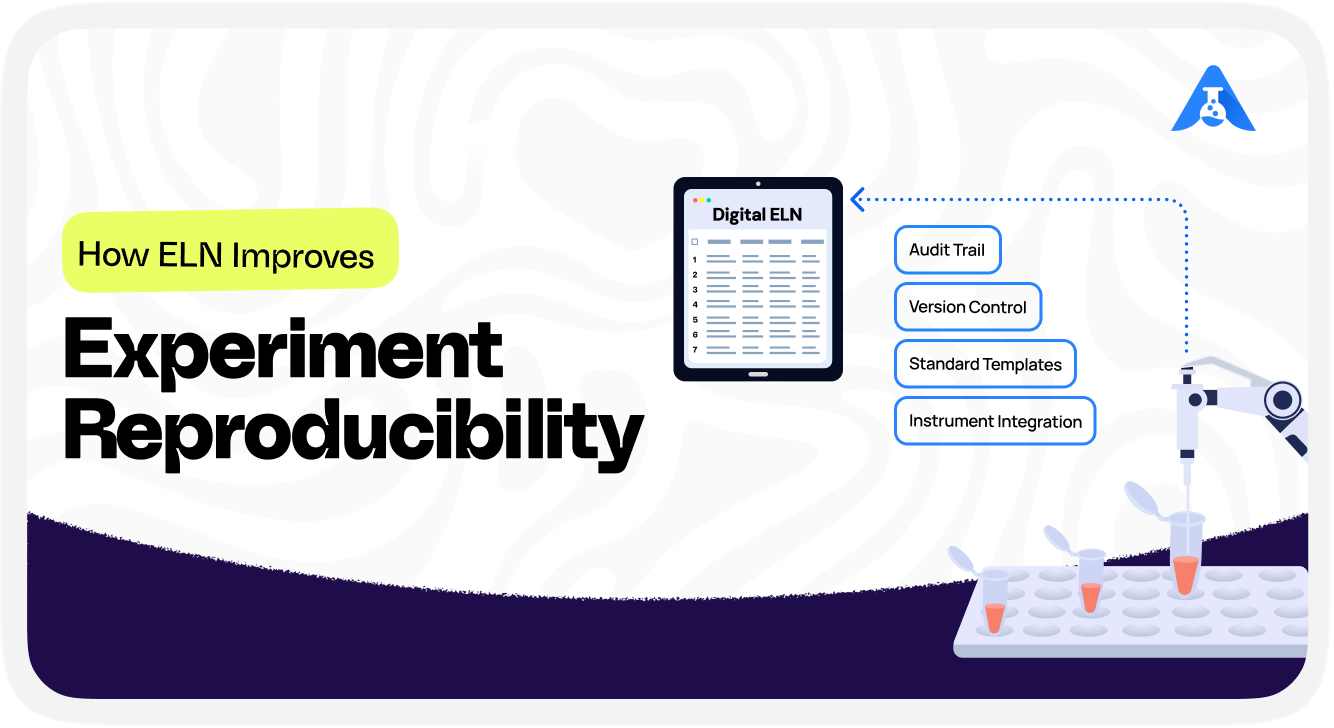
One of the most effective ways an Electronic Lab Notebook (ELN) improves scientific reproducibility is through standardized data capture. Instead of relying on individual researchers to document experiments in their own way, ELN software uses configurable templates, labsheets, and workflows to ensure that required fields, numeric values, dates, batch numbers, lot numbers, and expiry dates are recorded consistently every time. Mandatory fields, automated metadata capture, version control, audit trails, electronic signatures, role-based access, and centralized record management help strengthen data integrity and reduce documentation errors. By creating structured, searchable, and standardized records, an ELN improves collaboration, accelerates data retrieval, supports regulatory readiness, and provides a stronger foundation for reproducible research.
Protocol Templates and SOP Execution
While labsheets standardize data entry, protocol templates ensure experiments are executed and recorded in a consistent, step-by-step manner. Within an Electronic Lab Notebook (ELN), teams can design multi-step workflows that function as digital standard operating procedures, guiding researchers through each stage of an experiment. Each step can include embedded labsheets for structured inputs, calculations, images, chemical structures, plate data, and attachments, while automatically capturing timestamps, user actions, and step status such as started, completed, or skipped in a full audit trail.
This step-locked execution improves reproducibility by preventing steps from being missed or performed out of order. It ensures that every data point is captured at the exact point it is generated, rather than reconstructed later from memory or notes. It also creates a clear, navigable record of the experiment flow, making it easy for another researcher to replicate the process precisely as it was performed.
Version Control
One of the most common causes of irreproducibility is protocol version confusion, where an experiment is run using a method that later changes without clear tracking. A researcher may believe they are following the correct approved protocol, but a silent or unflagged revision can lead to another attempt using a different version, producing conflicting results that are difficult to interpret. An Electronic Lab Notebook (ELN), designed as audit-ready lab software, addresses this through built-in version control, which automatically records every change to protocols, templates, and data entries along with who made the change and when. It also provides side-by-side comparison of versions so differences are immediately visible. This ensures every experiment is permanently linked to the exact protocol version used at execution, removing ambiguity, strengthening scientific reproducibility, and ensuring reliable traceability while supporting compliance requirements such as 21 CFR Part 11, EU Annex 11, and GxP.
Cross-Linking and Tagging
Connecting related data across experiments and time points is essential for reproducible research. Lab sample tracking software and Electronic Lab Notebook (ELN) platforms support this through cross-linking and data tagging. Within an ELN, data can be linked across experiments and tasks, while custom tags allow researchers to standardize key parameters. These tagged fields can then feed directly into automated report generation, creating consolidated summaries across multiple experiments.
This connected structure improves reproducibility at the program level by enabling direct comparison of tagged parameters across studies without manual data aggregation. Instead of isolated records, the ELN creates a queryable knowledge base where patterns, trends, and outliers are easier to identify, helping determine which conditions consistently produce reliable results.
Multi-Site Collaboration
Enterprise ELN platforms use multi-site architecture to centrally manage workflows while allowing logically separated data, ensuring every site follows the same experimental structure without manual reconciliation. They also support controlled collaboration through role-based access, shared project assignment, real-time data sharing, tagging, and in-record comments, enabling seamless coordination and visibility across teams. This is especially critical for CROs, where consistent execution and cross-site data comparability are essential for reliable study outcomes.
Agaram’s Logilab ELN supports unlimited sites and teams within a single instance, giving lab leaders complete visibility across locations without compromising data security or site-level autonomy. Read how Logilab ELN helped a CRO
Instrument Integration
One of the most common but least visible sources of poor data quality in research laboratories is manual transcription, where researchers copy values from instrument displays into notebooks. Electronic Lab Notebook (ELN) software addresses this through direct instrument integration, capturing data automatically from instruments like cell counters, analytical balances, and HPLC systems into structured Labsheets using built-in parsing engines, eliminating manual entry.
This improves both accuracy and reproducibility by ensuring the ELN stores raw instrument output rather than human-transcribed values, allowing scientists to reproduce experiments using the same measured data. Advanced platforms like Logilab ELN also integrate with Qualis LIMS for validated result transfer and Logilab SDMS for instrument data extraction, along with external systems such as ERP and MES via REST APIs. This connected lab informatics ecosystem ensures data consistency, traceability, and reproducibility as information flows across systems at scale.
Want to check if your lab instruments are SDMS compatible? Get our list.
Audit Integrity
A paper notebook typically shows only the final record, while an Electronic Lab Notebook (ELN) captures the complete audit trail, recording every user action with timestamps, including data entry, edits, signatures, and status changes linked to the user and time of action in an immutable, searchable history. This makes ELNs a form of audit-ready lab software, providing critical reproducibility context such as whether data was entered in real time or reconstructed later, or whether protocols were followed sequentially. To further protect data integrity, role-based access control ensures users can only perform permitted actions, while electronic signatures validate changes to protocols, workflows, and records by capturing identity, time, and authorization details in compliance with 21 CFR Part 11 and supporting regulated and non-regulated environments alike. Together, audit trails, access control, and e-signatures make the research record trustworthy, traceable, and reproducible across scientific workflows.
Ready to Make Your Lab Reproducibility-Ready?
The best time to address reproducibility is before the audit, before the publication review, and before the study needs to be repeated from scratch. Logilab ELN offers a free version with no card details required, so your team can explore the platform, build templates, and experience structured experiment management before committing to a paid plan.
Conclusion
Reproducibility as a Strategic Advantage
As research grows more complex, reproducibility depends on the right systems for capturing and connecting data. A modern Electronic Lab Notebook (ELN) brings these elements together through integrated capabilities such as template-driven data capture, protocol execution, version control, audit trails, inventory tracking, instrument integration, role-based access, multi-site collaboration, and automated reporting, creating a complete, consistent, and traceable research record.
Agaram’s Logilab ELN is designed for both GxP-regulated and non-regulated environments, helping organizations maintain data integrity, compliance, and reproducibility as research grows. Schedule a personalized ELN software demo to see how it can support your workflows, documentation requirements, and compliance objectives.
- Introduction: The Reproducibility Crisis
- What Reproducibility Requires
- How ELN Improves Reproducibility
- Ready to Make Your Lab Reproducibility-Ready?
- Conclusion

Related articles

Data Traceability in Laboratories: Why It Matters
What Is Laboratory Traceability Laboratory traceability is the ability to trace the complete history of a s...

Clinical Research Data Management Best Practices
Managing Clinical Data Clinical research produces an immense and steadily growing volume of data across eve...

Managing Clinical Trial Samples with LIMS
Introduction: From Patient to Proof Clinical trial sample management is far more complex than routine labor...
 Contact Us