LIMS vs ELN vs SDMS vs QMS: What's the Difference and Do You Need All Four?
 Request a Demo
 Download Brochure
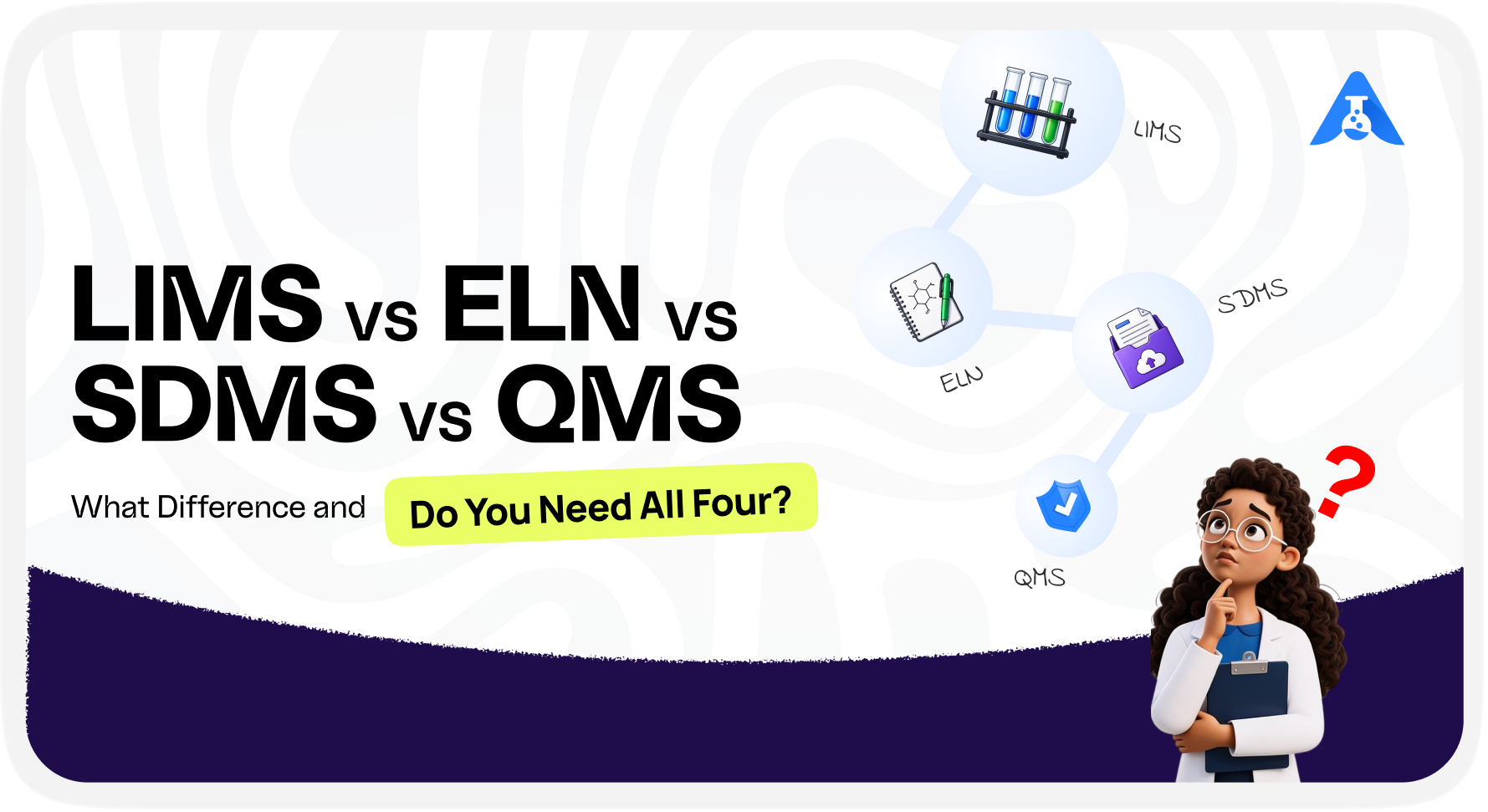
Walk into any laboratory digitalization discussion and you will quickly hear four acronyms: LIMS, ELN, SDMS, and QMS. While all four play a role in managing laboratory data and processes, they are designed for very different purposes. That naturally raises a few questions: What is the difference between them? Do laboratories need all four? And where should you start?
This guide explains what each platform does, the challenges it addresses, and how they work together as a connected laboratory informatics ecosystem. Whether you are evaluating a Laboratory Information Management System (LIMS), Electronic Lab Notebook software (ELN), a Scientific Data Management System (SDMS), or a Quality Management System (QMS), this comparison will help you understand where each solution fits and choose the right combination for your laboratory.
What Each Laboratory Informatics Platform Does
LIMS: The Operational Core
A Laboratory Information Management System manages the lifecycle of a sample from the moment it enters the laboratory to the moment a result is approved and reported. Sample registration, test assignment, result entry, specification checking, OOS management, approval workflows, and certificate of analysis generation (CoA) all fall under a LIMS. Every transaction in the system relates to a specific sample, test, or result, which is what makes a LIMS the system that tells the laboratory what to do today, in what order, and by whom.
A cloud-based LIMS software like Qualis LIMS extends this operational capability across sites and time zones without the infrastructure overhead of on-premises deployment, which matters most for organizations with multiple manufacturing locations or CRO operations managing concurrent studies. Built for regulated environments, it enforces GMP, 21 CFR Part 11, EudraLex Annex 11, ISO 17025, and ALCOA+ compliance structurally, through its architecture, rather than through procedural controls layered on top of a generic database.
ELN: The Digital Research Notebook
An Electronic Lab Notebook manages the intellectual record of scientific work rather than the operational lifecycle of a sample. It replaces the paper notebook where a scientist records what they did, why they did it, what they observed, and what they concluded. An ELN is organized around experiments, projects, and studies, and is where a scientist designs an experiment, records a protocol, documents instrument parameters, and attaches the data files that support a conclusion.
A fully compliant ELN, such as Logilab ELN, is built for laboratories operating under GLP, GCP, and GMP frameworks. The compliance architecture of the platform is the most critical evaluation criterion, because an ELN without version control, electronic signatures, and tamper proof records is not a real improvement on a paper notebook.
SDMS: The Raw Data Vault
Every analytical instrument produces raw data files such as chromatograms, spectra, and plate reader outputs. These files are the primary scientific evidence behind every result a laboratory reports, and in most laboratories, they sit entirely outside any controlled system.
An SDMS captures these raw data files automatically at the point of generation, regardless of instrument manufacturer or format, and archives them in a secure, centrally accessible repository with a permanent link to the corresponding sample and experiment. It ensures the original, unmodified instrument output is never overwritten and always retrievable on demand. Logilab SDMS connects directly to laboratory instruments through RS232 and TCP/IP interfaces, capturing every raw data file the moment it is generated, which is what satisfies the ALCOA+ original data requirement.
QMS: The Compliance Backbone
Where LIMS, ELN, and SDMS each manage a different type of laboratory data, a Quality Management System manages the processes that keep a laboratory compliant. A QMS governs document control, deviations, CAPA, change control, nonconformances, internal audits, training records, and management review, which are the quality processes that sit above day-to-day testing and research work.
Agaram Technologies’ Qualis QMS centralizes these processes so that a deviation raised during routine testing, a CAPA opened in response to it, and the document revision that resulted from it are all tracked in one connected record rather than across separate spreadsheets or paper forms. This matters because regulators do not just check whether a result was correct, they check whether the laboratory has a functioning system for catching and correcting problems.
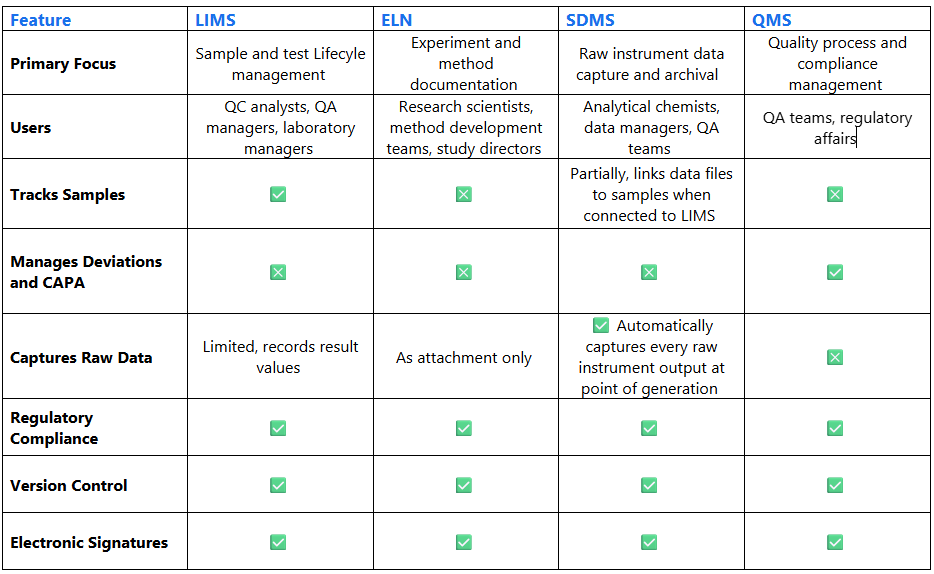
LIMS vs ELN vs SDMS vs QMS: Features Comparison
How LIMS, ELN, SDMS, and QMS Work Together
A common mistake laboratories make is treating these four platforms as competing systems rather than complementary ones. The real question is not which solution is best, but which combination supports the laboratory's complete data and compliance lifecycle. To see how these platforms work together in practice, let’s walk through a typical laboratory workflow:
The process typically begins in the ELN, where a scientist designs and documents a method validation protocol with timestamped, version-controlled entries. Once validated, the method moves into the LIMS as an approved, version-locked test, and the LIMS then manages routine QC operations, from sample registration through result approval. Logilab SDMS connects both environments by automatically capturing and archiving every raw instrument file, permanently linking it to the experiment or test result it supports.
Qualis QMS sits above all three, managing what happens when something goes wrong or needs formal review. If a result falls out of specification, a deviation is raised and routed through QMS. If a method needs to change, the change control process in QMS governs how that update is documented and rolled back into the ELN and LIMS. Together, the four platforms form a complete chain: the ELN documents how a method was developed, the LIMS records what was tested and by whom, the SDMS preserves the original instrument data, and the QMS governs the quality processes that catch and correct problems across all three.
LIMS vs ELN vs SDMS vs QMS: Choosing the Right System by Industry
Pharmaceutical Manufacturing QC: LIMS manages batch testing and sample tracking, SDMS secures the raw instrument data behind assay results, ELN supports method development, and QMS manages deviations and CAPA during GMP operations. A typical batch release cycle can involve all four systems, from raw material receipt and finished product testing to HPLC and dissolution data capture, validated methods, and deviation management before the batch can move forward.
Biotechnology & Life Sciences: ELN often serves as the starting point for documenting experimental protocols, observations, and research data. As programs progress toward regulated workflows and IND-enabling studies, LIMS supports controlled sample tracking, SDMS secures instrument data for regulatory submissions, and QMS manages change control, documents, CAPA, audits, and deviations, helping maintain compliance and inspection readiness. This allows the informatics infrastructure to evolve alongside the research program and its growing compliance requirements.
Clinical & Diagnostic Laboratories: LIMS manages patient samples and testing workflows, while SDMS supports data-intensive technologies such as mass spectrometry. QMS manages nonconformances, competency, and training records that support result reliability and accreditation requirements. Because patient results have direct clinical consequences, documenting that every analyst is qualified to perform a diagnostic assay is an important part of laboratory quality and compliance.
Contract Research Organizations: CROs often need all four platforms to provide complete traceability from study protocols and samples through raw instrument data and final results. ELN documents research activities, LIMS manages samples and regulated workflows, SDMS preserves original instrument data, and QMS manages deviations, CAPA, audits, and corrective actions. For CROs running multiple studies and sponsors simultaneously, QMS also helps maintain clear, separate, and attributable quality records for each sponsor, something that becomes increasingly difficult to manage manually as study volumes grow.
Food Safety & Water Testing: These laboratories operating under ISO 17025, use LIMS for sample registration and workflow management, SDMS for original instrument data and traceability, and QMS for internal audits, nonconformances, and corrective actions With high sample volumes and strict turnaround requirements, connecting LIMS and QMS supports both day-to-day efficiency and accreditation readiness. Resolving nonconformances through QMS before an assessment can also help prevent disruptive findings during audits. Top of Form
Looking for the right fit for your lab? Explore our solution brochure.
Bottom of Form
Choosing Between LIMS, ELN, SDMS, and QMS for Your Lab
Choosing between a LIMS, ELN, SDMS, and QMS should be based on your laboratory's workflows, regulatory requirements, and documentation needs, not just vendor recommendations. Use these questions to identify the right solution before evaluating LIMS software vendors:
- Do you process high volumes of samples that require registration, testing, approval, and reporting? If yes, a LIMS is your foundation. The best laboratory information management system centralizes sample tracking and result management.
- Are your scientists documenting research, method development, or validation studies instead of routine testing? If yes, an ELN is the right choice. ELN software for research labs replaces paper notebooks, spreadsheets, and Word documents with compliant, version-controlled records.
- Can you quickly retrieve original raw instrument data during audits or inspections? If not, you need an SDMS to ensure secure storage, traceability, and compliance with regulatory requirements.
- Do deviations, CAPAs, or document changes currently live in spreadsheets or paper files rather than a tracked system? A QMS brings that under a single, auditable process.
- Do you operate across multiple sites or laboratories? If yes, a cloud-based LIMS software with multi-site capabilities provides centralized, traceable, and accessible laboratory data.
- Are legacy instruments generating regulated data without 21 CFR Part 11 compliant data capture? If yes, an SDMS combined with a CFR Gateway helps close data integrity gaps and supports regulatory compliance.
Conclusion
Choosing between LIMS, ELN, SDMS, and QMS is not really a question of which single system is best. Each one solves a distinct problem inside the same laboratory. LIMS manages the operational lifecycle of a sample. ELN documents the scientific reasoning behind the work. SDMS preserves the raw instrument data behind every result. QMS governs the quality processes that catch and correct problems across all three. Understood separately, each can stand alone and still deliver value. Understood together, they form a connected record that carries a result from raw capture through experimental context to final approval, and into whatever corrective process follows if something goes wrong, which is what regulators and auditors expect a laboratory to demonstrate.
For labs just starting this evaluation, the right first step is whichever system addresses the most pressing gap today. The right long-term direction, for most regulated and research-intensive laboratories, is an integrated ecosystem where all four work from the same connected data flow.
Ready to transform your laboratory with a connected informatics ecosystem powered by LIMS, ELN, SDMS, and QMS? Schedule a personalized demo to see how our modern laboratory informatics solutions can support your workflows, compliance needs, and future growth.
- What Each Laboratory Informatics Platform Does
- LIMS: The Operational Core
- ELN: The Digital Research Notebook
- SDMS: The Raw Data Vault
- QMS: The Compliance Backbone
- LIMS vs ELN vs SDMS vs QMS: Features Comparison
- How LIMS, ELN, SDMS, and QMS Work Together
- LIMS vs ELN vs SDMS vs QMS: Choosing the Right System by Industry
- Choosing Between LIMS, ELN, SDMS, and QMS for Your Lab
- Conclusion