
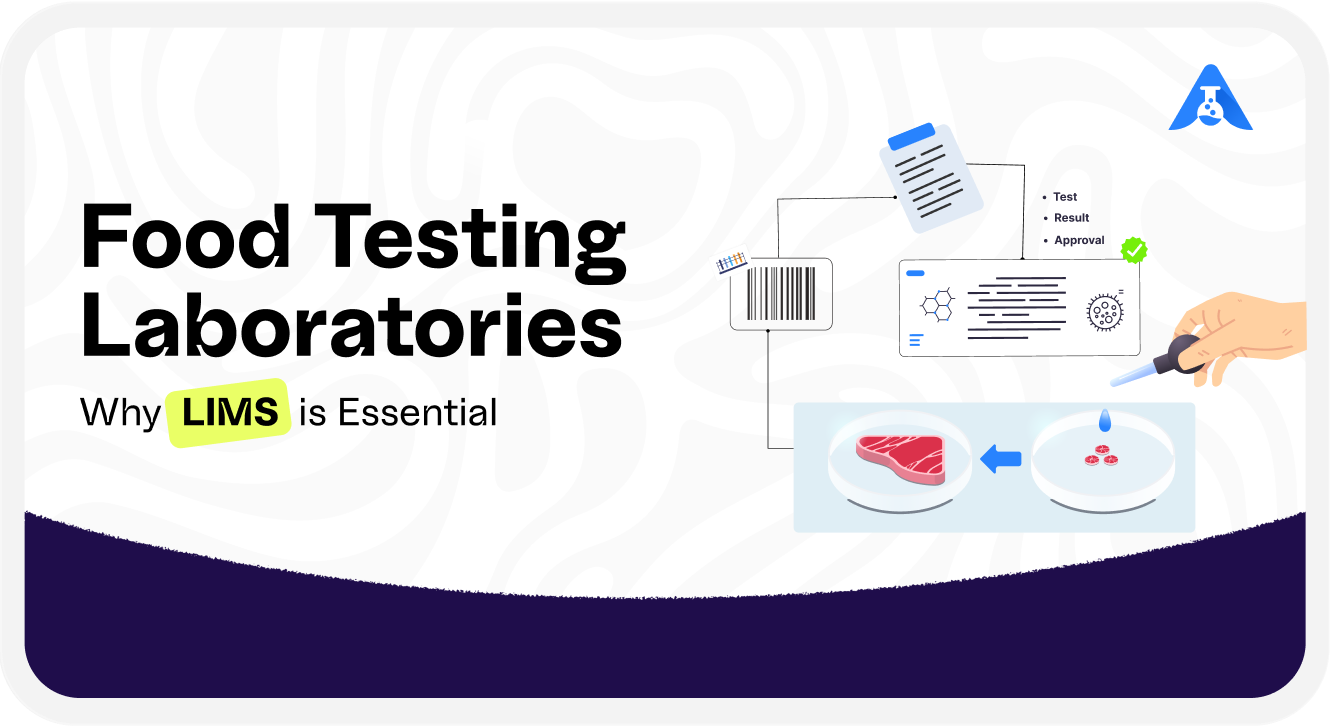
Food Testing Laboratories: Why LIMS is Essential
 Request a Demo
 Download Brochure
Introduction: When Food Safety Fails
Food safety is essential because millions of people rely on safe, high-quality food every day. Even a single contamination incident can lead to product recalls, regulatory action, financial losses, and risks to public health. As global food supply chains become more complex, accurate testing and complete traceability are more important than ever.
Food testing laboratories sit at the final line of defence between contaminated or adulterated food and the consumer who eats it. The volume of testing they perform is enormous, including microbial analysis, chemical contaminant screening, nutritional composition verification, pesticide residue testing, and shelf-life validation across thousands of raw materials, in-process, and finished product samples every month. The regulatory frameworks governing that testing, including FSMA in the United States, EU Food Law Regulation 178/2002, ISO 17025 for accredited laboratories, and HACCP, require that every result is documented, every method is validated, every instrument is calibrated, and every batch is traceable from ingredient to shelf.
Managing these requirements at scale without a Food Testing LIMS is not only inefficient but also increases the risk of compliance issues, delays, and errors.
How LIMS Transforms Food Testing
Sample Registration and Traceability
In a food testing laboratory, a single production batch often requires testing across microbiology, chemistry, allergen, and physical parameters. Paper-based workflows create separate forms, logbooks, and records, making it difficult to trace a contamination event back to a specific ingredient lot, supplier, or testing date during a product recall.
Lab sample tracking software such as Laboratory Information Management System (LIMS) simplifies this process by registering each sample once using a configurable template that captures supplier details, ingredient lot number, receipt date, storage conditions, and complete traceability metadata. A barcode is generated at registration, linking every sub-sample, test, result, approval, and disposal record throughout the sample lifecycle.
When a contamination investigation begins, the system can generate a complete traceability report within minutes, showing affected batches, ingredient lots, analysts, instruments, and test results.
Microbial and Chemical Testing Workflows
Food testing laboratories perform a wide range of analyses, including microbial testing for E. coli, Salmonella, and Listeria; chemical analysis for heavy metals, pesticide residues, mycotoxins, additives, and preservatives; nutritional labelling; allergen testing; and physical quality assessments. Each test requires its own method, instrument, acceptance criteria, and regulatory limits.
Agaram's Cloud-based LIMS software manages this complexity through configurable test groups and specification management. Each test is defined with its method, acceptance criteria, result type, and regulatory limits. When a sample is registered, the appropriate test panel is assigned automatically based on the sample type and product category. Version-controlled specifications ensure regulatory updates are applied consistently across all tests.
Method Validation and Documentation
Food testing laboratories regularly develop and validate analytical methods for new food matrices, expand accredited test menus, and generate method performance data to support ISO 17025 accreditation.
Logilab ELN provides a version-controlled digital environment for documenting method validation studies, recording observations in real time, and maintaining complete, 21 CFR Part 11 compliant and ISO 17025 aligned records. Once a method is approved, it is linked to the corresponding test definition in a food testing LIMS, creating a traceable connection between method validation and routine laboratory testing. This integrated workflow strengthens traceability, simplifies audits, and provides the documentation expected during laboratory accreditation.
Data Integrity and Traceability
In an ISO 17025 accredited food testing laboratory, raw instrument data is the primary scientific evidence supporting every reported result. HPLC chromatograms, ICP-MS spectra, and PCR amplification curves must be preserved in their original form and linked to the corresponding test record for audits, accreditation assessments, and regulatory inspections.
Logilab SDMS automatically captures raw instrument data at the point of generation, stores it in a secure, validated repository, and links it directly to the corresponding sample record in a LIMS software. Every result is permanently connected to its original data file, ensuring data integrity, complete traceability, and compliance with ALCOA+ principles and ISO 17025 raw data retention requirements.
Quality Control
Food testing laboratories operate under strict pass-fail conditions where results directly impact public health and regulatory compliance. A microbial count exceeding HACCP action limits in ready-to-eat food is not a minor deviation, but an immediate safety concern. Similarly, pesticide residues above EU maximum residue levels can stop an export shipment and require rapid traceability and response.
Food Testing LIMS addresses this by validating every result against specification limits in real time. If a result exceeds defined thresholds, automated alerts are triggered instantly to supervisors and QA teams. The system also manages a structured OOS workflow. Each non-conformance creates an investigation record with assigned ownership, root cause documentation, and controlled retesting if required. Retests are linked back to the original sample, ensuring full traceability. Final decisions such as release, rejection, or escalation are recorded with electronic signatures, creating a permanent audit-ready record.
Certificate of Analysis (CoA)
Every food testing laboratory ultimately delivers a report that defines what was tested, how it was tested, what was found, and whether it meets the required standards. This is the Certificate of Analysis, and in an ISO 17025 accredited laboratory, it is the official test report that determines product release, market access, and regulatory compliance.
Qualis LIMS automates Certificate of Analysis generation. Once final approval is completed, the CoA is automatically created using validated data from the system, including sample details, test parameters, results, specification limits, methods, instruments, analyst information, and electronic signatures. The report template designer allows QA teams to create customized CoA formats for different clients, regulatory requirements, product categories, and export markets.
Audit Trail and Regulatory Compliance
In paper-based food testing laboratories, assembling information from registers, logbooks, calibration files, training records, and method documents, making audit preparation time-consuming and fragmented.
Audit ready lab software such as Qualis LIMS ensures continuous audit readiness by automatically capturing every action in a secure, tamper-proof audit trail, all recorded with user identity, role, and timestamp. As laboratories transition to a fully paperless lab, records, approvals, and audit trails become digitally connected and always accessible. This non-editable audit trail, combined with role-based access control, ensures clear accountability across the workflow by identifying the analyst, reviewer, and QA approver through authenticated electronic identities. Electronic signatures support compliance with 21 CFR Part 11, EudraLex Annex 11, ISO 17025, and ALCOA+ data integrity principles, providing a unified compliance framework.
Download the LIMS brochure to see the full capabilities.
Building Future-Ready Food Testing Labs with Agaram
Food testing is not a static environment. Regulatory limits change, new contaminants emerge, trade requirements evolve, and allergen labelling mandates are updated with strict compliance deadlines. A laboratory that cannot quickly update test definitions, acceptance criteria, and report formats is always at risk of falling behind. Agaram’s Qualis LIMS is designed for this dynamic landscape, offering no-code configuration that allows QA teams to update specifications instantly when regulations change, without relying on IT teams or manual spreadsheet updates.
Its multi-site capability enables food testing networks, including national laboratories and enterprise QC setups, to operate on a unified platform with centralized master data and real-time visibility across all locations. As a global LIMS software provider, Agaram Technologies offers a laboratory informatics ecosystem adopted by over 250+ organizations across 30+ countries, backed by deep domain expertise, making it a reliable long-term informatics partner for modern laboratories.
Conclusion
Food testing sits at the intersection of laboratory science and public health, where accuracy, traceability, and compliance are non-negotiable. The system managing this work must match the rigor of the science itself. A food testing LIMS is not optional infrastructure for a modern laboratory but the operational foundation for delivering safe, traceable, and compliant results.
Request a personalized LIMS software demo to explore how end-to-end Food Testing LIMS automation can simplify workflows, strengthen compliance, and deliver complete traceability across every stage of food testing now!
- Introduction: When Food Safety Fails
- How LIMS Transforms Food Testing
- Building Future-Ready Food Testing Labs with Agaram
- Conclusion
Related articles

Data Traceability in Laboratories: Why It Matters
What Is Laboratory Traceability Laboratory traceability is the ability to trace the complete history of a s...

Clinical Research Data Management Best Practices
Managing Clinical Data Clinical research produces an immense and steadily growing volume of data across eve...

Managing Clinical Trial Samples with LIMS
Introduction: From Patient to Proof Clinical trial sample management is far more complex than routine labor...
 Contact Us