How SDMS Enables Centralized Scientific Data Management for Regulated Laboratories
 Request a Demo
 Download Brochure
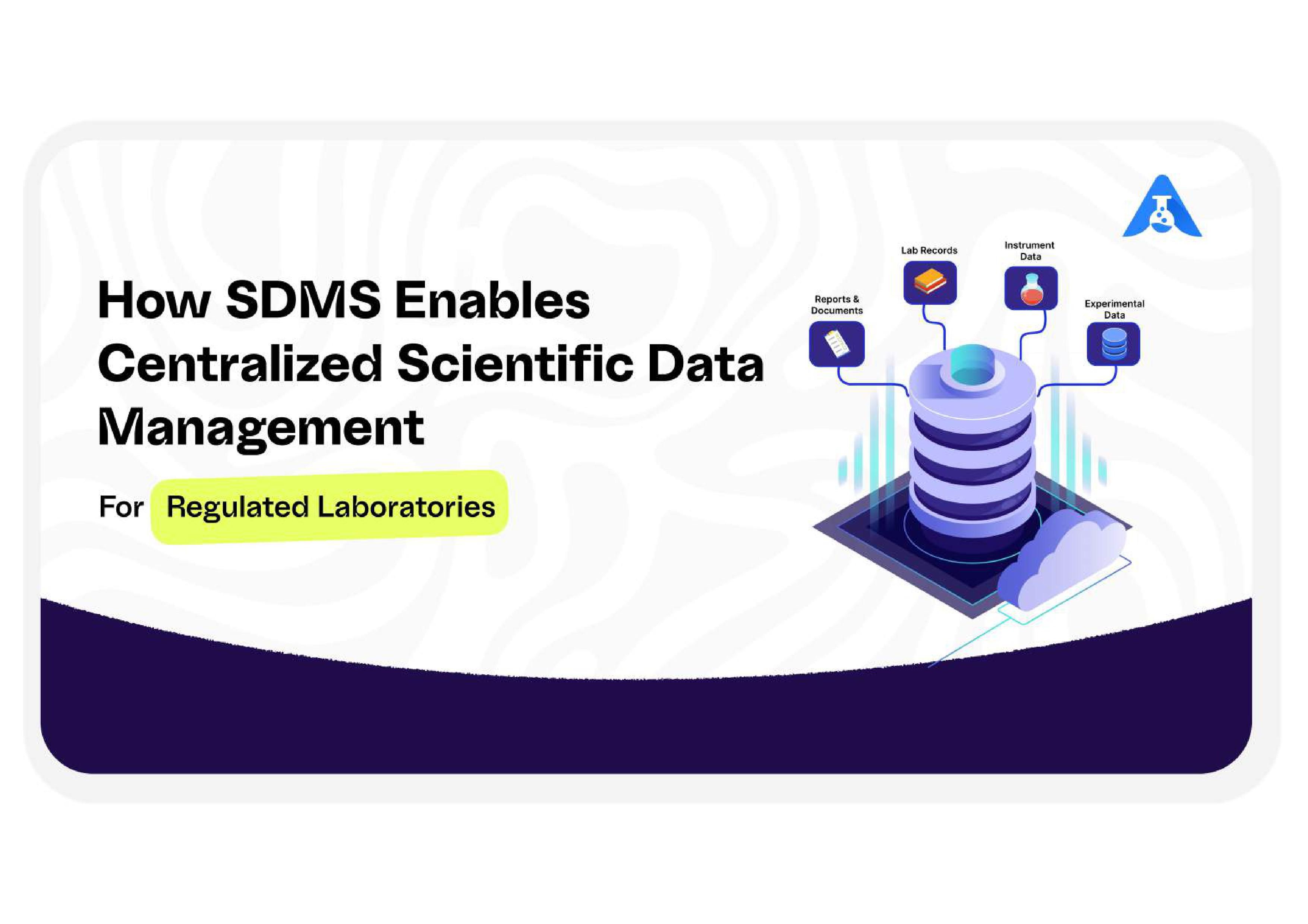
A regulated laboratory can run hundreds of instruments, with each one generating data that must be stored, traced, and retrieved when needed. When those records remain scattered across local drives, USB devices, and departmental folders, the laboratory has data but lacks centralized control. SDMS software addresses this challenge by bringing instrument-generated data into a governed repository, providing the foundation for centralized scientific data management.
This guide explains why centralized data management matters for regulated laboratories, how SDMS supports data integrity and regulatory requirements, and what to consider when evaluating an SDMS solution.
What Are Regulated Laboratories?
Regulated laboratories are scientific, analytical, and diagnostic testing facilities that operate under defined quality and regulatory requirements. Depending on their activities and location, they may follow standards such as Good Laboratory Practice (GLP), current Good Manufacturing Practice (cGMP), and other GxP requirements, along with data integrity expectations such as US FDA 21 CFR Part 11, EU Annex 11, and ALCOA+ principles.
These requirements apply across several types of laboratories, including:
- Pharmaceutical and biotechnology QC laboratories
- R&D and drug discovery laboratories
- Clinical research and contract laboratories
- Clinical diagnostics and biobanking laboratories
- Analytical development laboratories
While their workflows differ, these laboratories share one fundamental requirement: data must be accurate, traceable, secure, and readily available for review or inspection. Every result should be linked to its supporting record, and every record should provide sufficient evidence to demonstrate how the data was generated, processed, and maintained.
ALCOA+ and SDMS: Building Data Integrity
For regulated laboratories, centralized scientific data management is not just about keeping files in one place. It helps establish the controls needed to maintain data integrity, traceability, and regulatory compliance throughout the data lifecycle. When instrument data is automatically captured and stored in a controlled repository, laboratories can reduce manual handling while maintaining a clear record of how data was generated, processed, reviewed, and stored.
These controls support ALCOA+ data integrity principles, which require data to be attributable, legible, contemporaneous, original, accurate, complete, consistent, enduring, and available. An SDMS can support these principles through authenticated access, audit trails, timestamps, preservation of original files, metadata capture, version control, and data integrity checks. By building these controls into scientific data capture and management, regulated laboratories can strengthen compliance and make records easier to verify during audits and inspections.
Read how Logilab SDMS Software helped COVID-19 Vaccine Development.
How SDMS Software Enables Compliance and Centralized Data Management
SDMS software provides the technical foundation for centralized scientific data management in regulated laboratories. It helps control data from the point of capture through storage, review, retrieval, and integration with other laboratory systems. Its capabilities support laboratories across pharmaceutical QC, R&D, drug discovery, clinical diagnostics, biobanking, analytical development, and contract research.
Automated Data Capture Without Manual Intervention
Compliance begins at the point of data generation. Logilab SDMS uses background schedulers to automatically capture files from PC-based instruments, while standalone devices can connect through RS232, TCP/IP, or analog interfaces. Clinical IVD analyzers can connect through Agaram Technologies' Interfacer middleware, while integration options support chromatography data systems.
This is particularly valuable in pharmaceutical QC and clinical diagnostics, where high volumes of instrument data are generated every day. Automated capture records data when it is generated, reducing manual transcription and helping maintain accurate and contemporaneous records.
Secure Archiving and Version Control
Captured files are transferred through secure FTP or SFTP to centralized cloud or on-premises storage. Logilab SDMS preserves the original instrument folder structure and supports auto-versioning, version rollback, time-stamped file locking, checksum validation, and automated backups.
This centralized approach is especially useful for pharmaceutical QC, R&D, drug discovery, and analytical development laboratories managing large volumes of chromatograms, imaging files, screening data, method files, and other scientific records. A human-readable PDF can also be generated alongside the original raw file to support long-term readability and review.
Access Control and Audit Trails
Logilab SDMS uses granular role-based access controls at the file, folder, instrument, and user levels, with authentication through Active Directory. Electronic signature gates can also be configured for data review, approval, and release workflows.
These controls are particularly important for contract research organizations (CROs) managing data for multiple clients. Logical data segregation and controlled permissions help keep studies separated while maintaining a clear audit trail of user activity and changes to scientific records.
Managing Data from Legacy Instruments
Many legacy GxP instruments lack modern compliance features such as electronic signatures, audit trails, or controlled data storage. To resolve this within the Logilab SDMS framework, Agaram Technologies provides CFR Gateway as a specialized compliance wrapper. CFR Gateway address this gap by adding compliance controls around electronic data workflows from legacy instruments. This enables pharmaceutical, biotechnology, and analytical laboratories to extend centralized data management and compliance controls to existing equipment without replacing an entire instrument fleet.
Connecting SDMS With LIMS and ELN
Logilab SDMS can work alongside Qualis LIMS and Logilab ELN to connect raw instrument data with samples, experiments, and validated results. Parsed instrument values can be shared through REST APIs, while the original data remains stored in the SDMS repository.
Conclusion
For regulated laboratories, centralized scientific data management is about more than storing files in one place. It is about knowing where every record comes from, who accessed it, and whether it can be retrieved when needed. When data is scattered across instrument PCs, folders, and different systems, even a simple audit request can turn into hours of searching and verification.
An SDMS software brings these records into a controlled environment, helping laboratories reduce manual handling while maintaining data integrity, traceability, and accessibility. With the right data management approach, laboratories can spend less time managing scattered records and more time generating reliable scientific results.
Bring scattered instrument data into one controlled environment with SDMS. See how centralized scientific data management can simplify data retrieval, improve traceability, and keep your laboratory audit ready. Book your personalized SDMS demo today!
- What Are Regulated Laboratories?
- ALCOA+ and SDMS: Building Data Integrity
- How SDMS Software Enables Compliance and Centralized Data Management
- Automated Data Capture Without Manual Intervention
- Secure Archiving and Version Control
- Access Control and Audit Trails
- Managing Data from Legacy Instruments
- Connecting SDMS With LIMS and ELN
- Conclusion