
Future of Smart Laboratories: AI, Automation & Laboratory Informatics
 Request a Demo
 Download Brochure
Introduction
The Laboratory Is Getting Smarter
The laboratory has always been the place where precision meets purpose. It is where a pharmaceutical batch is cleared for human use, where a food product is confirmed safe for the shelf, where a patient's blood tells the story of their health, and where a petroleum refinery knows its product meets the spec before it leaves the plant. For decades, the tools inside those four walls have been exceptional. The systems managing the work inside them have not kept pace.
That is changing rapidly. The smart laboratory is no longer a concept from a technology conference keynote. It is an operational reality being built and adopted across industries right now, powered by the convergence of automation, intelligent lab systems, IoT connectivity, and laboratory informatics platforms that connect every element of lab work into a single, traceable, digital ecosystem.
This blog examines what a smart laboratory is and how the technologies driving this transformation look like in practice across the industries that depend on laboratory science most.
What Is a Smart Laboratory?
A smart laboratory is a digitally connected and AI-enabled environment where laboratory operations, instruments, data systems, workflows, and compliance processes work together through an integrated informatics ecosystem. In a smart laboratory, samples are registered digitally, routed automatically, tracked through barcodes, and tested using integrated instruments that transfer results directly into the system without manual transcription. As structured, instrument-linked data grows across connected platforms, it creates the foundation for machine learning models to predict instrument failures, detect anomalies, and identify quality risks before they become compliance issues. AI and automation help identify deviations, flag out-of-specification results, monitor trends, optimise workflows, and generate actionable insights from laboratory data in real time.
This operating model is powered by laboratory informatics, automation, instrument integration, and IoT connectivity. Agaram's smart laboratory ecosystem combines Qualis LIMS, Logilab ELN, Logilab SDMS, and Qualis DMS into a connected laboratory informatics platform. Together, these solutions integrate laboratory workflows, instrument data, compliance processes, documentation, automation, and ALCOA+ data integrity practices to create a fully traceable, efficient, and audit-ready smart laboratory environment.
Automation across the ecosystem eliminates manual coordination. The result is a smart laboratory that operates with greater speed, consistency, compliance readiness, and operational efficiency.
Smart Laboratory vs Traditional Laboratory: The Operational Gap
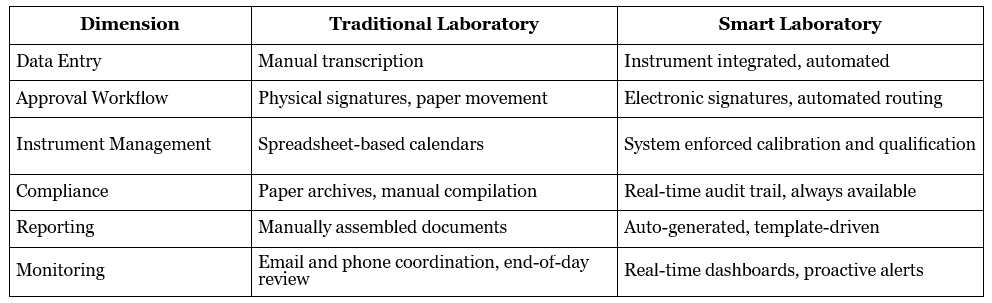
In a traditional laboratory, sample registration is a manual process. An analyst writes sample details into a paper register, assigns a handwritten ID, and attaches a handwritten label. That information is then re-entered into a spreadsheet when results are recorded. The same data exists in two places, entered by hand twice, with two opportunities for transcription error.
Test methods and specifications exist in paper binders or uncontrolled Word documents on shared drives. There is no guarantee that the analyst running a test today is using the same version of the method that was used six months ago. Instrument results are read from a screen or printout and entered manually into a logbook. Calibration status is tracked in an Excel file maintained by one person. An out-of-calibration instrument may be used in formal testing without anyone realising it until an audit reveals the record.
Approvals require physical signatures on physical documents that travel between desks or floors. In a multi-site organisation, batch release documents may be couriered between cities.
The smart laboratory eliminates every one of these friction points.
Learn more about Paperless labs.
The Technologies Powering the Smart Laboratory
Laboratory Informatics: The Central Nervous System
The core of any laboratory informatics ecosystem is the Laboratory Information Management System (LIMS). LIMS manages the end-to-end lifecycle of every sample: registration, test assignment, result capture, specification checking, approval, reporting, and archival. It is the system of record for everything the laboratory does, and every other informatics platform in the ecosystem connects to it.
Agaram Technologies has spent over two decades building a comprehensive laboratory informatics ecosystem around this principle. At its core, Qualis LIMS manages the full sample lifecycle, including compliance workflows, instrument management, inventory tracking, training and certification, stability studies, and environmental monitoring across industries. Supporting this, Logilab ELN provides a structured, version-controlled, 21 CFR Part 11 compliant electronic lab notebook for recording experiments, executing test methods, and documenting research. Logilab SDMS captures raw instrument data directly from analytical instruments of any make or model, creating a verified and centralised source of truth. Qualis DMS manages SOPs, policies, quality records, and change control workflows to ensure that laboratory documents remain current and approved, while the Interfacer middleware connects clinical IVD instruments with hospital information systems to parse and route patient diagnostic data in real time.
Together, these five platforms form a connected laboratory informatics architecture where no data is siloed, no record is paper-based, and no compliance gap exists. This architecture is the foundation of the smart laboratory.
Download the Brochure to learn more about cloud-based LIMS.
AI, ML and Automation
The intelligence of a smart laboratory operates across three connected levels: rules-based automation, machine learning, and AI-driven analytical assistance. Rules-based automation eliminates manual coordination by triggering actions automatically based on real-time laboratory conditions. In Qualis LIMS, finished product samples can auto-load approved test panels, OOS results can automatically initiate investigation workflows, calibration due dates can restrict instrument usage, and inventory thresholds can trigger procurement alerts without manual intervention. This automation layer improves operational efficiency, compliance enforcement, and turnaround time across pharmaceutical, food, clinical, and petroleum laboratories.
Machine learning moves the laboratory from reactive automation to predictive intelligence. By analysing historical laboratory data such as calibration trends, instrument usage, environmental conditions, analyst activity, and result history, machine learning models can predict instrument failures, detect result anomalies, and identify quality risks before they become compliance events. Applications include predictive maintenance for HPLC systems and analytical balances, anomaly detection for statistically unusual results that remain technically within specification, and stability prediction modelling that helps pharmaceutical and life sciences laboratories identify degradation risks earlier in the product lifecycle.
AI-driven analytical assistance adds a cognitive layer above laboratory data systems. Using natural language query interfaces, QA managers and scientists can interact with laboratory data using plain-language requests instead of complex database queries. AI-assisted analytics can surface trends, deviations, retest patterns, analyst-specific variations, and instrument-related quality risks in seconds. In R&D environments, AI-assisted method development is also emerging to support analytical method optimisation, formulation development, and stability prediction based on structured historical datasets.
While AI is increasingly supporting faster and more informed decision-making, regulated laboratories still require human oversight for critical GMP, GLP, and ISO 17025 quality decisions. The role of AI in today's smart laboratory is to augment human expertise, improve consistency, and strengthen compliance readiness rather than replace human accountability.
IoT and Instrument Connectivity
In a traditional laboratory, instruments operate in isolation, requiring analysts to manually transfer results into record systems. In a smart laboratory, instruments become active participants in the connected informatics ecosystem through IoT and real-time instrument integration. Analytical instruments continuously transmit results, operational parameters, temperature, pressure, run status, error codes, and environmental conditions directly into connected laboratory platforms without manual intervention.
Logilab IoT Connect enables real-time instrument connectivity and IoT integration across smart laboratory environments. It connects laboratory instruments, sensors, environmental monitoring systems, and analytical equipment with platforms like Qualis LIMS and Logilab SDMS using RS232 or TCP/IP communication protocols. The platform automates live data capture, instrument monitoring, environmental tracking, and direct data transfer, eliminating manual transcription while improving traceability, compliance, and operational efficiency across connected laboratory workflows.
In pharmaceutical QC labs, this means HPLC assay results and dissolution profiles, flow directly into Qualis LIMS without any analyst transcription. In food and dairy laboratories, milk analysers report fat, protein, and lactose content in real time, enabling automated batch grading before the tanker is even unloaded. In clinical diagnostics, hematology and biochemistry analysers connected through Agaram's Interfacer middleware deliver patient results to the laboratory information management system (LIMS) and HIS simultaneously, without any manual data movement between systems.
See how IoT Connect solves this.
Conclusion
Where Smart Laboratories Are Going
Smart laboratories are rapidly transforming industries including pharmaceuticals, food, beverage and dairy, clinical diagnostics, and petroleum by combining laboratory informatics, IoT-enabled instrument connectivity, automation, and real-time compliance management. These connected ecosystems help laboratories improve traceability, accelerate turnaround time, strengthen data integrity, and maintain continuous compliance with regulations such as 21 CFR Part 11, EU Annex 11, ISO 17025, GLP, GxP, and ALCOA+ principles.
The next phase of the smart laboratory is being shaped by machine learning, predictive maintenance, anomaly detection, and AI-assisted analytics. These capabilities depend on clean, structured, instrument-linked laboratory data generated through integrated informatics ecosystems. Laboratories investing in connected digital infrastructure today are building the foundation required for future-ready intelligent laboratory operations.
Take the next step toward a smarter laboratory with Agaram’s integrated informatics solutions — book a personalised demo for an audit ready software today.
- Introduction
- What Is a Smart Laboratory?
- Smart Laboratory vs Traditional Laboratory: The Operational Gap
- The Technologies Powering the Smart Laboratory
- Conclusion

Related articles

Data Traceability in Laboratories: Why It Matters
What Is Laboratory Traceability Laboratory traceability is the ability to trace the complete history of a s...

Clinical Research Data Management Best Practices
Managing Clinical Data Clinical research produces an immense and steadily growing volume of data across eve...

Managing Clinical Trial Samples with LIMS
Introduction: From Patient to Proof Clinical trial sample management is far more complex than routine labor...
 Contact Us