21 CFR Part 11 and EU Annex 11: How SDMS Supports Electronic Records and Data Integrity
 Request a Demo
 Download Brochure
What happens when an auditor asks for a record from an instrument you ran three years ago? Finding the file is only the beginning. You also need to show that it is the original, identify who handled it, and prove that it has not been altered.
This is exactly where 21 CFR Part 11 and EU Annex 11 set the expectations for how electronic records and data should be managed in regulated environments. For laboratories dealing with growing volumes of instrument data, meeting those expectations manually can become difficult, especially when records are scattered across instrument PCs and shared folders.
An SDMS helps bring these controls into the data lifecycle, from automated capture and secure storage to access control, audit trails, and preservation of original records. This guide looks at what the two regulations require and how SDMS software can support those requirements in practice.
What is 21 CFR Part 11?
21 CFR Part 11 is a US FDA regulation covering electronic records and electronic signatures in FDA-regulated environments. For laboratories operating under GxP frameworks such as cGMP and GLP, it sets expectations for trustworthy electronic records, secure user authentication, electronic signatures, and time-stamped audit trails.
In practice, this means laboratory records should be traceable, secure, and attributable throughout their lifecycle. Every result, file, and approval should have a clear history showing who performed an action, when it happened, and whether the record was changed.
Read how Logilab SDMS supports 21 CFR Part 11 Compliance
What is EU Annex 11
EU Annex 11, also known as EudraLex Annex 11, covers computerized systems used in GMP-regulated activities in Europe. It sets expectations for controlled access, data protection, audit trails, system reliability, and the integrity of electronic records throughout their lifecycle.
Laboratories operating across US and European markets may need to meet both 21 CFR Part 11 and EU Annex 11 requirements. For these teams, the focus is on having systems that can consistently control, protect, and trace electronic data throughout its lifecycle.
Read how Logilab SDMS enables EU Annex 11 Compliance
21 CFR Part 11 vs EU Annex 11: Key Requirements
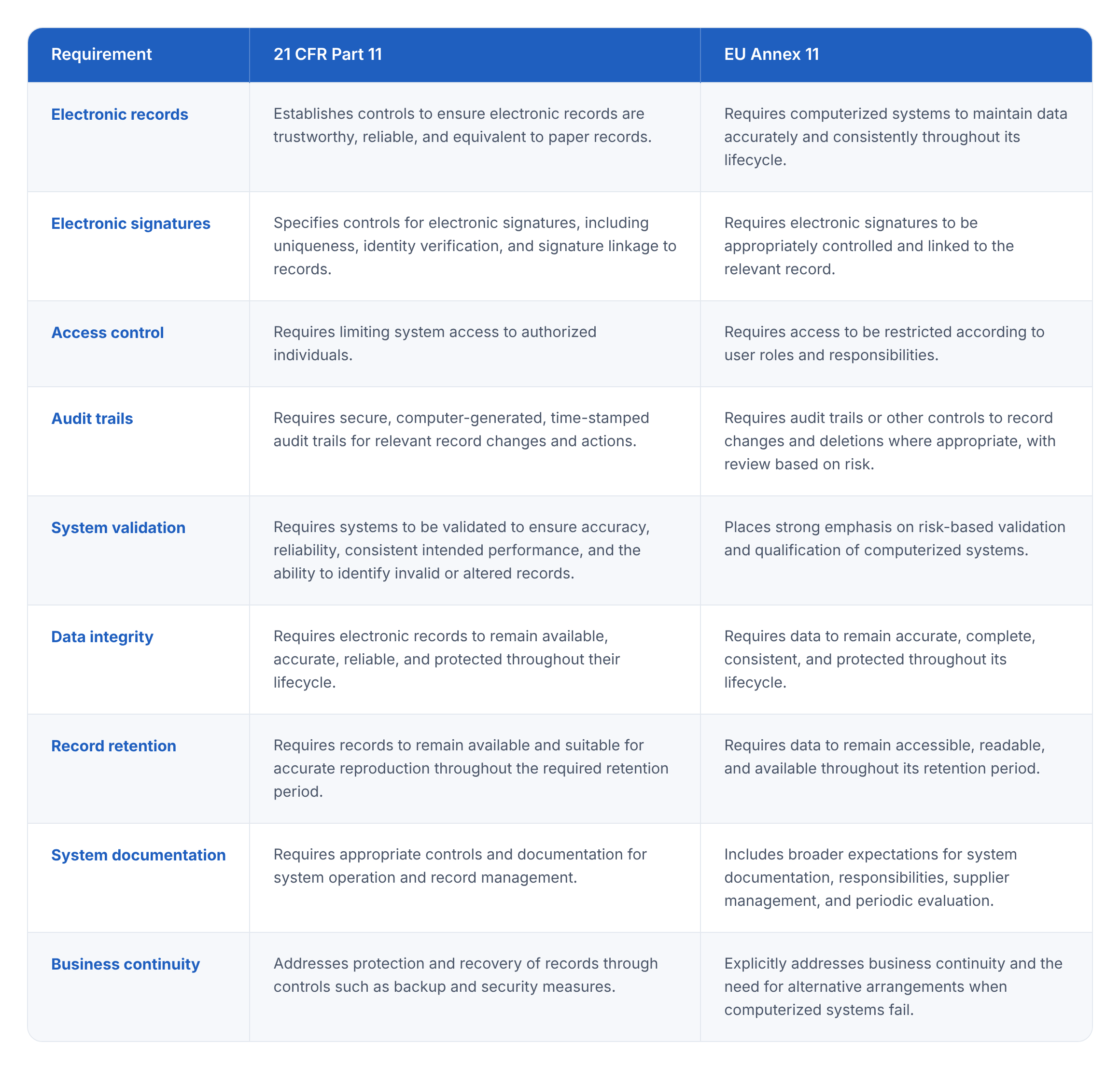
The challenge is putting these requirements into practice consistently. Analysts may still copy files between workstations, save data on local drives, retype results, or work with older instruments that lack user controls and audit trails. Each manual step creates an opportunity for missing records, errors, or unexplained changes.
SDMS software helps reduce this dependency on manual processes by automating data capture, controlling access, preserving original files, and recording activities throughout the data lifecycle. This makes data integrity and compliance controls part of the workflow rather than relying entirely on individual users to maintain them.
How SDMS Software Supports Compliance: 21 CFR Part 11 & EU Annex 11
SDMS software helps laboratories apply controls that support US FDA 21 CFR Part 11, EudraLex Annex 11, GLP, cGMP, and ALCOA+ data integrity principles. It automates data capture, secure archiving, access control, audit trails, and record management while providing a centralized source for instrument data. Software alone does not make a laboratory compliant, since validation, procedures, and training are also required, but however, the right SDMS can make these controls easier to implement and demonstrate.
Electronic Records and Readable Outputs
Compliance starts with how electronic records are captured and preserved. Logilab SDMS automatically collects data from PC-based instruments through background schedulers and connects with standalone instruments through RS232, TCP/IP, or analog ports.
Raw files are transferred through secure FTP or SFTP, while the original instrument folder structure is preserved in the central repository. The platform can also generate human-readable PDF copies through a virtual printer driver, making records easier to review without requiring the original instrument software.
Access Control and Authentication
Both 21 CFR Part 11 and EU Annex 11 require controlled access to computerized systems and electronic records. Logilab SDMS supports granular role-based access at the user, group, instrument, folder, and file levels. It can also integrate with Windows Active Directory for centralized user authentication and single sign-on.
This allows laboratories to define who can view, manage, review, or approve specific data while keeping actions linked to authenticated users.
Electronic Signatures and Workflows
Electronic signatures provide a controlled way to document approvals and reviews. Logilab SDMS supports signature gates within custom review, approval, and document release workflows, as well as electronic signatures for audit trail review and data approvals.
This brings formal sign-off into the electronic workflow instead of relying on separate paper or email-based approvals.
Audit Trails and Monitoring
Audit trails provide a history of what happened to a record and who performed each action. Logilab SDMS records activities such as file uploads, downloads, restorations, modifications, version history, and metadata changes. It also tracks scheduler activity, Windows service states, communication failures, and other system events.
Local file operations such as deletions, modifications, and renaming on connected workstations can also be captured, helping laboratories maintain a more complete record of data activity.
Original Data and Version Control
Regulated laboratories need to preserve original records and demonstrate that they have not been improperly altered. Logilab SDMS uses time-stamped file locking, auto-versioning, and version history to help protect and track electronic records. Version rollback also allows earlier versions to be retrieved when required for review or inspection.
Checksum validation can verify file integrity during transfer, helping confirm that the stored record matches the source file generated by the instrument.
Legacy Instruments Integration
Many laboratories also still use GxP instruments that lack modern controls such as audit trails, user authentication, or electronic signatures. Replacing these systems can be costly and disruptive.
To resolve this within the Logilab SDMS framework, CFR Gateway, Agaram Technologies' compliance module, helps bring electronic data workflows from legacy standalone instruments closer to 21 CFR Part 11 requirements. This allows laboratories to extend data integrity controls to existing equipment while continuing to use trusted instruments.
Download SDMS brochure to explore compliance features in detail.
Conclusion
Meeting 21 CFR Part 11 and EU Annex 11 requirements becomes much easier when compliance controls are built into the way laboratory data is captured and managed. Instead of chasing files, checking manual records, or reconstructing what happened after the fact, laboratories can use SDMS software to automate capture, protect original data, control access, and maintain a traceable history. This reduces the burden on analysts and quality teams while helping maintain data integrity throughout the record lifecycle. With the right processes and validation in place, laboratories can stay better prepared for regulatory review and ensure records are easier to retrieve, review, and defend during an inspection.
What happens when an auditor asks for the original data? Would your lab be able to produce it, trace its history, and prove its integrity? See how Logilab SDMS captures, protects, and traces instrument data from source to record. Book a free personalized SDMS demo and see how your audit trail could look today!
- What is 21 CFR Part 11?
- What is EU Annex 11
- 21 CFR Part 11 vs EU Annex 11: Key Requirements
- How SDMS Software Supports Compliance: 21 CFR Part 11 & EU Annex 11
- Electronic Records and Readable Outputs
- Access Control and Authentication
- Electronic Signatures and Workflows
- Audit Trails and Monitoring
- Original Data and Version Control
- Legacy Instruments Integration
- Conclusion