Open-Source vs Commercial LIMS: Which Is Right for Your Lab?
 Request a Demo
 Download Brochure
Beyond the feature checklist, every laboratory evaluating a Laboratory Information Management System (LIMS) eventually faces a key decision: should you choose an open-source LIMS or a commercial LIMS backed by a vendor and support services? Open-source platforms can be attractive for research groups with in-house technical expertise and the resources to manage implementation and ongoing development. Commercial LIMS solutions, meanwhile, typically offer vendor support, structured implementation, maintenance, and capabilities suited to laboratories with more complex operational or regulatory requirements.
The choice becomes particularly important for laboratories operating under GxP, FDA, or ISO requirements, where data integrity, validation, security, technical support, and long-term system maintenance need to be considered alongside the initial software cost. This blog compares open-source and commercial LIMS across the factors that matter most, including cost, implementation, customization, support, compliance, scalability, and total cost of ownership.
Open-Source vs Commercial LIMS: What You Need to Know
An open-source LIMS provides access to its source code, allowing laboratories to inspect, modify, and redistribute the software. This gives technically capable teams greater control and flexibility but also places more responsibility on the laboratory for implementation, security, maintenance, and upgrades.
Key characteristics of open-source LIMS:
- Source code access and modification
- Greater responsibility for system configuration and maintenance
- In-house or third-party technical expertise
- Self-managed upgrades and security
- Custom integration and development requirements
- Potentially lower upfront software licensing costs
A commercial LIMS is developed, maintained, and supported by a software vendor through a licensing or subscription model. The vendor typically provides implementation support, product updates, technical assistance, and configurable functionality, reducing the amount of software management required from the laboratory.
Key characteristics of commercial LIMS:
- Vendor-supported implementation and maintenance
- Regular software updates and technical support
- Configurable workflows and laboratory processes
- Built-in security and compliance capabilities
- Integration with instruments and other laboratory systems
- Flexible deployment options, including on-premises and cloud
- Licensing or subscription costs based on the commercial model
Open-Source vs Commercial LIMS: How They Differ
Open-Source vs Commercial LIMS: Which Is Right for Your Lab?
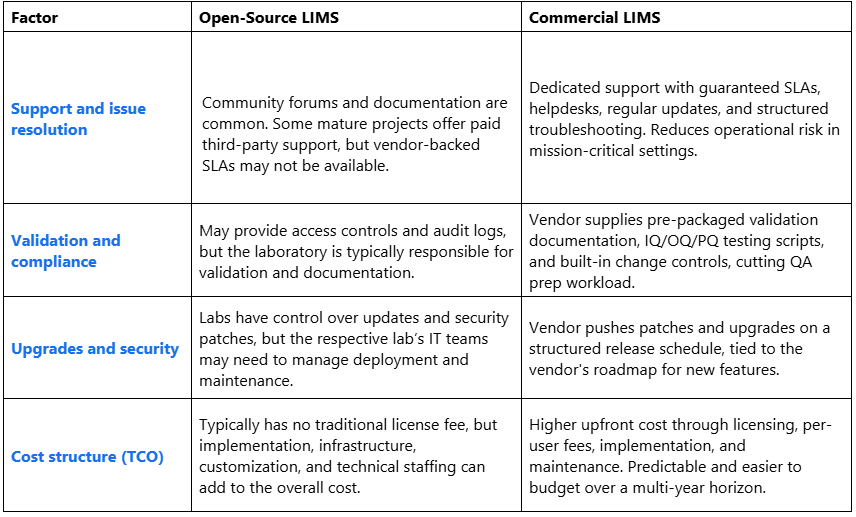
Choosing between an open-source LIMS and a commercial LIMS depends on your laboratory’s regulatory requirements, operational risk, customization needs, IT capabilities, and long-term support expectations.
Pharmaceutical and clinical labs working under requirements such as FDA 21 CFR Part 11 or EudraLex Annex 11 typically need strong controls for electronic records, audit trails, data integrity, access management, and validation. CROs also need an audit-ready environment that can support multiple sponsors and studies, while Diagnostic labs place particular importance on uptime, turnaround time, technical support, and business continuity. Chemical, food, and environmental testing labs may need flexibility across ISO/IEC 17025, and other customer or industry requirements. In these regulated and operationally critical environments, a commercial LIMS can reduce the internal burden through vendor-supported implementation, validation resources, security controls, upgrades, and technical support. For Research and academic laboratories, an open-source LIMS can be a practical option when regulatory requirements are limited, and the organization has sufficient technical expertise.
An open-source LIMS may be suitable when:
- Regulatory requirements are relatively limited
- Your lab has strong internal IT or development expertise
- Extensive customization is a priority
- Your team can manage maintenance, upgrades, security, and integrations
- Vendor-backed support and SLAs are not essential
A commercial LIMS is a stronger choice when:
- Your laboratory operates in a regulated or compliance-sensitive environment
- Validation, audit trails, data integrity, and electronic records are critical
- You need vendor-supported implementation and validation resources
- System downtime could significantly affect laboratory operations
- You require reliable technical support and defined SLAs
- You need scalable workflows, integrations, regular upgrades, and ongoing product support
- You want to reduce the internal effort and risk associated with managing a mission-critical laboratory system
Qualis LIMS for Compliance & Security
Regulated laboratories, particularly those operating in pharmaceutical, clinical, and other GxP environments, need more than basic data storage. Qualis LIMS supports regulated laboratory workflows with features designed around data integrity, traceability, and compliance. It supports FDA 21 CFR Part 11 and EU GMP Annex 11 requirements through an automated, time-stamped audit trail that records user actions and maintains a complete history of laboratory activities. The platform also supports standardized workflows and controlled access, helping laboratories maintain the quality records and traceability required for ISO 17025 environments. Data in transit and at rest is protected using AES-128 encryption, with security practices aligned with OWASP 3.0 and SANS benchmarks.
Achieving similar levels of documented compliance and security with a self-managed open-source LIMS is possible, but much of the responsibility falls on the laboratory's internal team or external technical partners. The lab may need to configure security controls, develop validation documentation, manage updates, maintain auditability, and establish processes for ongoing compliance.
Conclusion
Open-source and commercial LIMS address the same core laboratory management needs, but they place responsibility in different hands. An open-source LIMS can reduce licensing costs, but requires greater internal ownership of validation, maintenance, security, and ongoing support. A commercial LIMS shifts much of that operational burden to the vendor while providing structured compliance support, reliable maintenance, and technical assistance. For regulated laboratories where validation, audit readiness, data integrity, and uptime directly impact business and compliance outcomes, a commercial LIMS built for GxP and paperless laboratory operations can offer a more reliable, scalable, and lower-risk approach.
Want to make the switch to smarter LIMS management? Discover Qualis LIMS’ powerful features, and built-in compliance capabilities for modern laboratories. Schedule your free personalized LIMS demo today!
- Open-Source vs Commercial LIMS: What You Need to Know
- Open-Source vs Commercial LIMS: How They Differ
- Open-Source vs Commercial LIMS: Which Is Right for Your Lab?
- Qualis LIMS for Compliance & Security
- Conclusion