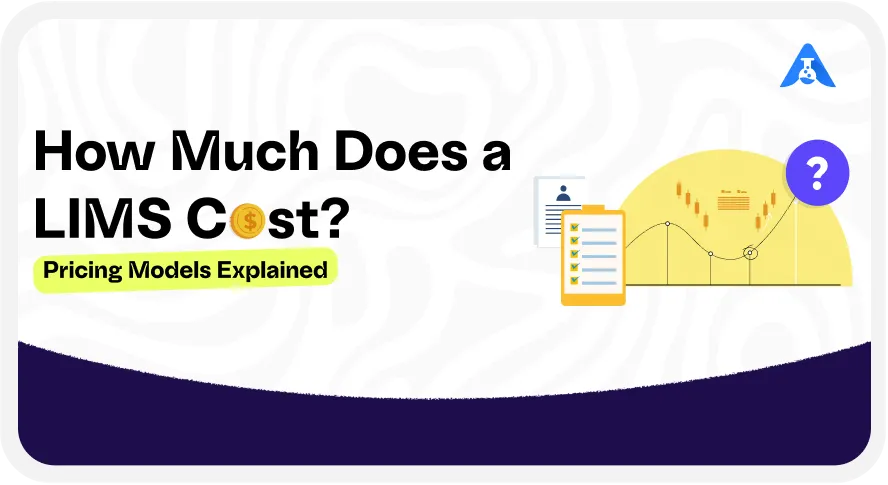
How Much Does a LIMS Cost? Pricing Models Explained
 Request a Demo
 Download Brochure
Asking how much a LIMS costs is a bit like asking how much a car costs. The answer depends on the model, pricing structure, features, and how you plan to use it over the long term. LIMS pricing works much the same way. The license or subscription fee is only one part of the overall investment, with implementation, validation, integrations, training, upgrades, and support also contributing to the total cost.
This blog explores the main LIMS pricing models, the factors that influence costs beyond the initial license, and how to calculate total cost of ownership (TCO). Understanding these costs upfront can help you compare LIMS solutions more effectively and choose a platform that fits both your laboratory requirements and long-term budget.
Understanding LIMS Pricing Models
Perpetual Licensing
A perpetual license is the traditional commercial software model. It requires a higher upfront investment, but the laboratory receives the right to use the licensed version indefinitely. Additional costs may include annual support and maintenance, upgrades, and new modules, with maintenance fees often calculated as a percentage of the initial license cost.
Qualis LIMS supports perpetual licensing across on-premises, customer-owned cloud, and Agaram-hosted cloud deployments, allowing laboratories to combine software ownership with their preferred infrastructure model.
SaaS Subscription
A Software-as-a-Service (SaaS) model uses recurring monthly or annual subscription fees, reducing the upfront investment required to deploy a LIMS. The software and supporting infrastructure are hosted and maintained by the provider, which can reduce the need for laboratories to purchase and manage their own servers.
Qualis LIMS offers SaaS subscriptions for its cloud deployment options, providing an accessible model for laboratories that prefer predictable recurring costs and want to minimize upfront infrastructure investment.
Open-Source or Zero-License
An open-source or zero-license LIMS eliminates traditional software licensing fees and may also avoid per-user or per-feature charges. However, this does not mean the system is cost-free. Laboratories may still incur significant expenses for implementation, customization, infrastructure, integrations, upgrades, and ongoing technical support.
The key consideration is where the cost sits. While the initial software license may be free, the laboratory may need to invest more internal resources or specialized expertise to deploy, maintain, and support the platform over time.
What Influences LIMS Implementation Costs
Adapting a LIMS to match laboratory workflows is often one of the largest cost drivers, and it is where pricing discussions can become unclear if requirements are not addressed early. This includes workflow and form configuration, such as designing test-specific parameters, data entry screens, and approval paths, as well as test and specification setup, where raw material, in-process, and finished product testing requirements are configured in the system.
In commercial proprietary systems, extensive customization is often vendor-driven, which can increase costs when laboratory workflows require significant changes beyond standard configuration. Open-source systems shift these costs differently, as workflow changes may require in-house developers or external specialists to modify the underlying code. A configurable platform like Qualis LIMS can help make implementation costs more predictable by allowing many workflow requirements to be managed through configuration.
Validation Costs
For laboratories operating under GxP, FDA 21 CFR Part 11, or ISO 17025 requirements, a LIMS must undergo formal validation before it can be used in production, making validation an important cost to consider beyond the software license. Commercial vendors often provide pre-packaged validation documentation and IQ/OQ/PQ testing scripts, reducing the workload for quality teams, while open-source systems may require laboratories to develop, execute, and document validation activities internally. Qualis LIMS is designed with GxP requirements in mind and supports FDA 21 CFR Part 11 and EudraLex Annex 11 through features such as an automated, unalterable audit trail, helping laboratories maintain data integrity and audit readiness.
Integration and Data Migration Costs
Connecting a LIMS with laboratory instruments and enterprise systems is essential for reducing manual data entry and improving data accuracy, but it can add to implementation costs. Instrument integrations, middleware, and connections with systems such as hospital platforms, ELNs, and ERP solutions like SAP may require additional configuration or specialized integration work depending on complexity. Data migration should also be considered separately, as transferring historical records from paper logbooks, spreadsheets, or legacy SQL databases into a new LIMS can require significant effort. Commercial vendors may provide migration services to reduce internal workload, while open-source implementations may require custom scripts and technical resources to transfer legacy data securely and accurately.
Deployment and Infrastructure Costs
Where a LIMS is deployed can significantly affect the overall budget. On-premises deployment may require investment in servers, database licenses, backup storage, load balancers, and ongoing IT maintenance. Cloud deployment shifts these infrastructure requirements to virtualized environments managed either by the laboratory's IT team or by the LIMS vendor as a fully managed service. This makes cloud-based LIMS software an attractive option for laboratories looking to reduce upfront infrastructure investment and maintain more predictable operating costs.
Training Costs
Training is an important but often overlooked component of LIMS total cost of ownership, regardless of the pricing model. Commercial vendors may charge professional service fees for training end users, administrators, and other stakeholders, while open-source systems may require third-party trainers or significant internal time for self-learning. Laboratories migrating from a legacy system should also account for the time and resources required to retrain analysts, supervisors, quality teams, and IT staff on the new platform. Beyond direct training fees, pulling employees away from routine testing can temporarily reduce laboratory throughput and create operational delays, making a structured and efficient onboarding program essential for controlling both training costs and implementation disruption.
Support and Long-Term Maintenance Cost
The final piece of the LIMS pricing picture is the cost of support and maintenance after go-live. Commercial LIMS support typically includes SLA-based technical assistance, troubleshooting, security patches, system updates, and ongoing maintenance, usually covered through an annual maintenance contract (AMC) or subscription fee. An AMC can provide continued technical support, access to product updates, and assistance with system issues, helping laboratories maintain reliable operations over the long term. Open-source LIMS implementations often rely on community documentation and forums, so regulated laboratories may need dedicated technical staff or an external support partner for SLA-backed maintenance. These ongoing support and AMC costs should be included when calculating the total cost of ownership, rather than comparing software license prices alone.
Conclusion
Choosing the right LIMS requires looking beyond the initial software price. Licensing or subscription fees are only one part of the overall investment, while implementation, customization, validation, training, integrations, maintenance, and ongoing support can significantly affect the total cost of ownership. The right pricing model ultimately depends on the laboratory’s size, workflows, regulatory requirements, technical resources, and long-term growth plans. A detailed evaluation helps minimize unexpected costs and identify a platform that delivers reliable value over the long term.
Looking for a LIMS That Fits Your Budget and Compliance Needs? Discover how a LIMS can streamline laboratory operations while supporting your regulatory and business requirements. Request a personalized LIMS demo today!
- Understanding LIMS Pricing Models
- Perpetual Licensing
- SaaS Subscription
- Open-Source or Zero-License
- What Influences LIMS Implementation Costs
- Validation Costs
- Integration and Data Migration Costs
- Deployment and Infrastructure Costs
- Training Costs
- Support and Long-Term Maintenance Cost
- Conclusion