LIMS for CROs, Diagnostics, Chemical & Food Labs: What Changes by Industry
 Request a Demo
 Download Brochure
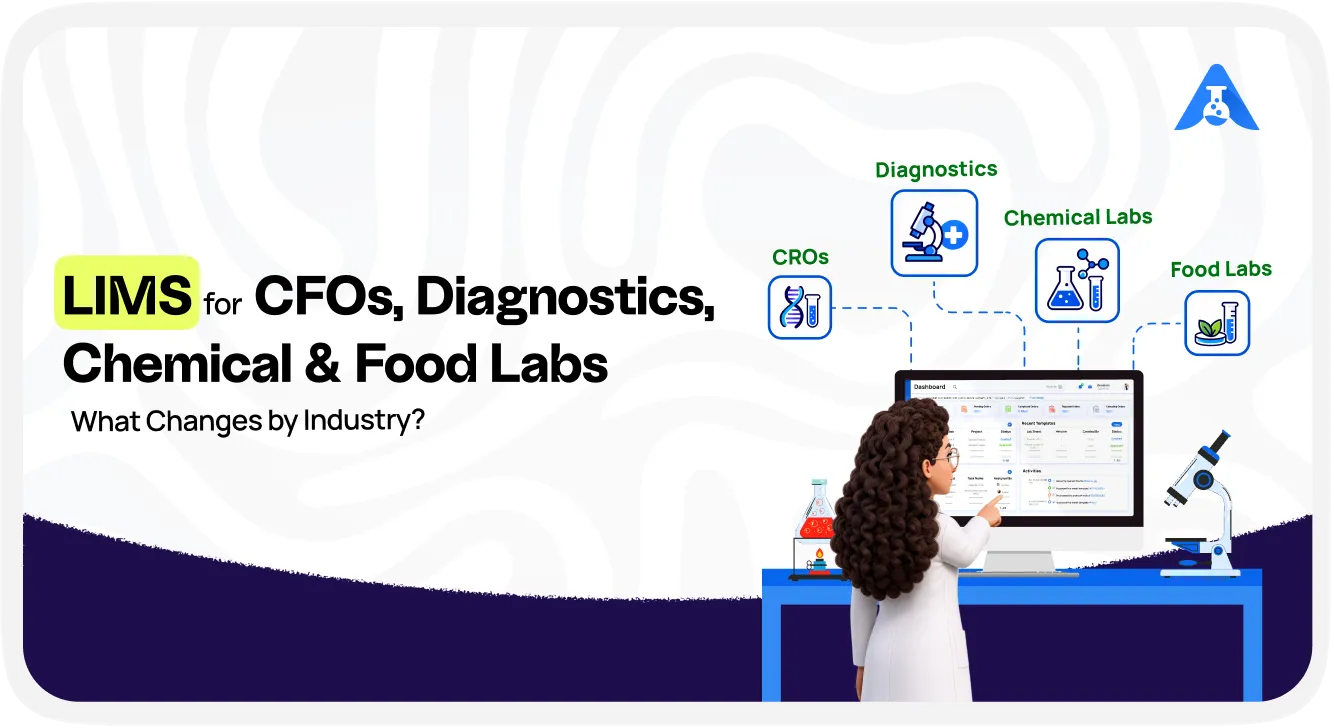
A Laboratory Information Management System (LIMS) may seem like one software category, but its role can vary significantly across industries. A CRO managing clinical trials has very different requirements from a food safety lab testing contaminants or a diagnostic lab handling patient samples with same-day turnaround. Each environment comes with its own compliance requirements, especially when managing large volumes of samples across multiple studies, sponsors, and testing workflows.
If you are exploring cloud-based LIMS software, understanding these industry-specific requirements can make it easier to compare solutions. This guide looks at what CRO, diagnostic, chemical, and food testing laboratories need from their LIMS how a configurable platform like Qualis LIMS, a cloud-based LIMS by Agaram Technologies can adapt to different laboratory workflows.
LIMS for CROs: Managing Samples, Studies, and Compliance
Contract Research Organizations (CROs) often manage multiple client studies at the same time, with different sponsors, protocols, timelines, and reporting formats. A CRO LIMS needs to keep study data securely separated while giving lab managers visibility across the overall workload. Study directors also need to track sample chain of custody from intake to disposal, while sponsors expect audit-ready data with a complete, traceable record available whenever required.
In such cases, GLP-compliant lab software is essential for maintaining traceability across CRO workflows. It ensures that every result is linked to the analyst, instrument, and protocol version used during testing. Configurable study and protocol workflows can help CROs onboard new sponsors without rebuilding processes from scratch. For teams handling early discovery or method development alongside routine testing, integrating LIMS with ELN provides researchers with a structured environment for documenting experimental observations and raw data that can later support formal study records.
LIMS for Diagnostic Labs: Streamlining Samples and Results
From sample registration and tracking through testing and result release, each stage in a diagnostic laboratory requires efficient workflows and accurate data exchange. A diagnostic LIMS connects these processes within a single workflow, providing the sample traceability and process control needed for high-volume testing.
For diagnostic labs, Qualis LIMS goes beyond sample tracking by supporting barcode-driven sample tracking and configurable result flagging, helping reduce manual data entry and sample identification errors during high-volume testing. Its turnaround time (TAT) monitoring provides visibility into workflow delays, making it easier to identify bottlenecks. A specialized Biorepository module provides blueprint-based tracking of deep-freeze storage layouts, supporting sample aliquoting, retrieval, and disposal with full audit traceability.
To reduce transcription errors from high-throughput analyzers, Qualis LIMS integrates with Logilab SDMS (Scientific Data Management System) to capture and parse raw diagnostic instrument data directly at the point of origin. The platform also uses RESTful service APIs to establish secure data bridges between the LIMS and external enterprise systems, such as Hospital Information Systems (HIS), enabling seamless exchange of sample and result information.
So, by connecting samples, instruments, results, and reporting in a streamlined workflow, Qualis LIMS helps improve diagnostic laboratories operational efficiency while maintaining the speed, accuracy, and traceability required for diagnostic testing.
LIMS for Chemical Labs: Enhancing Testing and Quality Control
Chemical laboratories support activities ranging from raw material testing and manufacturing quality control to formulation, stability studies, and environmental analysis. These labs often manage multiple samples and tests against predefined specifications, making traceability and consistent result management essential. A chemical laboratory LIMS helps organize samples, schedule testing, manage specifications, track results, and maintain a complete record from sample receipt through final approval.
For instance, QC teams may need to verify whether a finished formulation meets predefined specifications before it is approved for the next stage. Qualis LIMS helps QC teams manage batches, define test-level specifications, automate pass/fail evaluation, handle OOS investigations, and generate Certificates of Analysis (COAs). To ensure the accuracy and reliability of analytical chemistry data, the platform maintains a complete history of laboratory equipment, including validation logs, routine maintenance, and calibration schedules. Its inventory management module also categorizes and tracks critical chemical supplies, including reagents, volumetric solutions, and standards, while monitoring expiration dates and automatic reorder levels. This gives chemical laboratories better visibility into testing, faster result review, and stronger control over batch quality and laboratory resources.
LIMS for Food Testing: Managing Multi-Disciplinary Testing
Food testing laboratories work across a wide range of regulatory and quality requirements, including FDA food safety regulations, ISO 17025 accreditation, and client-specific specifications from food manufacturers. A single laboratory may perform microbiological, nutritional, chemical, and contaminant testing, with each test requiring its own methods, hold times, specifications, and reporting requirements.
Qualis LIMS supports multiple test panels and configurable reporting templates, helping laboratories manage different testing disciplines while maintaining consistent data and reporting processes. Its dedicated Stability Studies module streamlines shelf-life testing by automating stability protocol scheduling and sample pull dates, while supporting stability trend reports that help establish and validate product expiration dates. Dynamic registration templates can also be configured across the food testing lifecycle, enabling laboratories to track raw agricultural materials, in-process batches, and finished products using automated barcode labels. Complete, time-stamped records and traceable workflows help laboratories maintain reliable data and stay prepared for regulatory inspections.
LIMS for Pharma: GxP Compliance & Data Integrity
Pharmaceutical laboratories operate at the strictest end of the GxP compliance spectrum, particularly when managing regulated sample and batch testing. For CROs, chemical laboratories, and other organizations serving pharmaceutical clients, 21 CFR Part 11, EU GMP Annex 11, ALCOA+ data integrity principles, electronic signatures, and complete audit trails are fundamental requirements. A pharmaceutical LIMS should provide these controls as part of the core system to support secure, traceable, and compliant management of laboratory data throughout the testing lifecycle.
Qualis LIMS is designed to support pharmaceutical laboratories in managing samples, batch testing, results, and laboratory workflows with the controls needed for data integrity, traceability, and regulatory compliance. To eliminate transcription risks, the system supports direct integration with analytical instruments to automate result entry, ensuring raw data is securely and accurately captured at the point of origin. For pharmaceutical R&D activities, Logilab ELN complements the LIMS by supporting experiment documentation, protocols, and research data. Together, LIMS and ELN connect research and experimentation with formal laboratory testing, helping organizations maintain data integrity, traceability, and compliance throughout the laboratory workflow.
Explore the LIMS built for your lab. Learn more about Qualis LIMS.
How to Choose the Right LIMS for Your Laboratory
CROs, diagnostic, chemical, food, and pharmaceutical labs have different needs, so LIMS selection should focus on your workflow, compliance requirements, and future growth rather than a generic feature checklist. Before shortlisting LIMS providers, consider:
Compliance: Does the LIMS support your applicable requirements, such as GLP, GMP, or ISO 17025, with appropriate audit trails, electronic records, and data integrity controls?
Workflow Fit: Can the system support your sample types, testing processes, approvals, reporting, and day-to-day laboratory operations?
Integration: Can it connect with your laboratory instruments, ELN, SDMS, HIS, ERP, or other existing systems to reduce manual data entry?
Configurability: Can workflows, templates, specifications, and reports be configured as your laboratory requirements change?
Scalability: Can the LIMS handle increasing sample volumes, users, tests, and clients as your laboratory grows?
Traceability: Does it provide complete visibility into samples, results, approvals, changes, and other laboratory activities?
Ease of Use: Can scientists and QA/QC teams adopt the system without adding unnecessary complexity to their daily workflows?
Conclusion
CRO, diagnostic, chemical, food testing, and pharmaceutical laboratories each place different demands on a LIMS, but the underlying goal remains the same: accurate results, complete traceability, efficient workflows, and data that stands up to audit. The right LIMS should adapt to how your laboratory operates rather than forcing your team to change established processes around the software. Understanding your industry's testing requirements, compliance obligations, integrations, and day-to-day workflows is the first step toward selecting a system that fits today and can scale with your laboratory as its needs evolve.
Ready to Find a LIMS Built Around Your Lab? Schedule a free personalized LIMS demo to discover how Qualis LIMS can adapt to your processes and support your laboratory as it grows.
- LIMS for CROs: Managing Samples, Studies, and Compliance
- LIMS for Diagnostic Labs: Streamlining Samples and Results
- LIMS for Chemical Labs: Enhancing Testing and Quality Control
- LIMS for Food Testing: Managing Multi-Disciplinary Testing
- LIMS for Pharma: GxP Compliance & Data Integrity
- How to Choose the Right LIMS for Your Laboratory
- Conclusion