
Things To Consider While Choosing A LIMS Solution In 2026
 Request a Demo
 Download Brochure
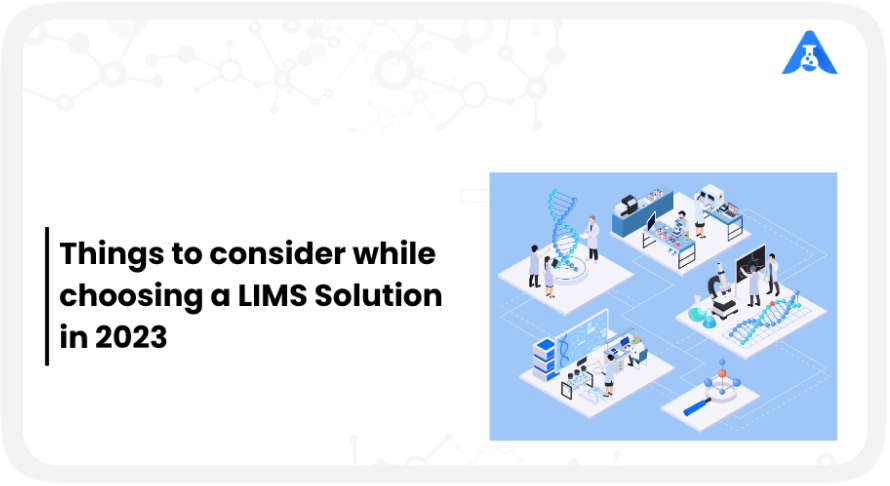
Laboratories worldwide have moved beyond asking whether they need a Laboratory Information Management System (LIMS) and are now asking which solution best fits their operations. Modern laboratories use LIMS software to register samples, capture test data, and manage instruments, calibration schedules, inventory, and compliance records in one connected system. Without a Laboratory Information Management System, data can become scattered across spreadsheets and paper records, making audits more difficult and slowing reporting.
So, choosing the right LIMS software is no longer simple checklist exercise. Laboratories need to consider their regulatory requirements, long-term budget, scalability, workflows, and user needs before selecting a LIMS service provider. As laboratories continue to modernize in 2026, understanding these factors can help organizations choose a LIMS solution that supports both current operations and future growth.
Key Factors to Consider When Choosing a LIMS
Understand Your Lab's Requirements
Before comparing vendors, define operational and compliance requirements. A LIMS software should support industry-specific regulatory guidelines while remaining flexible enough to accommodate changing requirements. Clear requirements help prevent implementation delays, unexpected costs, and workflow gaps.
Check Provider Experience
A provider’s track record can indicate implementation expertise and long-term reliability. Consider experience in the LIMS platform market and the relevance of the existing customer base. An experienced LIMS provider should demonstrate strong knowledge of laboratory processes, efficient implementation practices, effective user training, and responsive technical support.
Assess Long-Term Support
A LIMS represents a long-term investment, making ongoing support as important as initial implementation. A reliable LIMS software provider should support configuration, legacy data migration, system integration, upgrades, and technical issues throughout the LIMS lifecycle. Strong customer support helps maintain system performance and user adoption.
Compare Total Costs
When comparing LIMS pricing, consider total cost of ownership rather than initial licensing costs alone. Open-source LIMS options may offer lower upfront costs, while customization, deployment, integration, maintenance, and technical support can increase long-term expenses. Commercial LIMS platforms often provide more predictable subscription or maintenance costs and dedicated technical support. A five-year total cost of ownership (TCO) comparison provides a more accurate view of overall investment.
Prioritize Configuration
Older LIMS software often required code-level changes to support laboratory workflows. Modern LIMS platforms increasingly emphasize configuration, allowing laboratory administrators to create custom templates and workflows with minimal coding. High configurability simplifies adaptation to new studies, clients, tests, and regulatory requirements.
Check Compliance & Validation
Laboratories operating under GxP, FDA 21 CFR Part 11, EudraLex Annex 11, or ISO/IEC 17025 should prioritize regulatory compliance and data integrity when selecting LIMS software. Important capabilities include automated audit trails, role-based access controls, electronic signatures, and data integrity controls
The validation approach also requires consideration. Commercial LIMS providers may offer validation documentation, including Installation Qualification (IQ), Operational Qualification (OQ), and Performance Qualification (PQ) resources. Clear validation responsibilities help laboratories estimate implementation timelines and QA requirements.
Assess Integration
A modern LIMS system should function as an operational hub rather than an isolated application. Integration with laboratory instruments, Electronic Lab Notebooks (ELN), ERP, QMS, and MES platforms helps connect laboratory data across systems. Reliable APIs and integration capabilities can reduce manual data entry and transcription errors.
Evaluate Innovation & Expertise
Laboratory requirements continue to evolve, making product innovation and scalability important LIMS selection criteria. Regular platform upgrades, new capabilities, and technology innovation can support changing laboratory needs.
Domain expertise also plays an important role. A LIMS provider with experience in the relevant industry is more likely to understand laboratory workflows, data management requirements, and regulatory expectations. Industry expertise can support more effective LIMS configuration and faster implementation of new capabilities.
How Qualis LIMS Supports Different Industries
LIMS requirements vary by industry, laboratory type, regulatory environment, and workflow complexity. Qualis LIMS is an industry-agnostic, configurable Laboratory Information Management System designed to support QC, research, healthcare, commercial, and regulated laboratories. The platform combines sample management, testing, workflow automation, reporting, compliance, instrument integration, and centralized data management, making it suitable for laboratories ranging from smaller teams to multi-site operations.
Pharmaceutical
Pharmaceutical and biopharmaceutical laboratories require strong regulatory compliance, data integrity, stability management, batch testing, and quality control. Qualis LIMS supports GxP, FDA 21 CFR Part 11, EudraLex Annex 11, and ISO 17025 requirements, while providing workflows for batch testing, stability studies, environmental monitoring, CAPA, deviations, and compliant reporting.
Clinical & Healthcare
Clinical laboratories need fast sample processing, accurate results, traceability, and reliable reporting. Qualis LIMS supports patient sample management, barcode-based tracking, configurable testing workflows, reference ranges, result flagging, and reporting, helping clinical and healthcare laboratories manage high-volume testing with greater efficiency. Qualis LIMS also supports requirements relevant to ISO 15189 for medical and clinical laboratories.
Life Sciences & Biotech
Biotech and life sciences laboratories generate complex research data across instruments, experiments, and distributed teams. Qualis LIMS can centralize sample and test information, while Logilab SDMS captures, catalogs, and archives instrument data from multiple sources. Together, the solutions support secure data management, collaboration, and integration across research environments.
Clinical Research & CROs
Clinical research and contract research organizations (CROs) need structured workflows for studies, samples, results, and data traceability. Qualis LIMS can support clinical trial specimens and research samples, while the broader informatics ecosystem such as Logilab ELN supports BA/BE studies, bio-clinical data, centralized data management, and multi-site collaboration.
Food, Dairy & Beverage
Food and beverage laboratories need efficient quality testing across raw materials, in-process materials, and finished products. Qualis LIMS supports batch testing, sample grading, quality checks, instrument data capture, SAP and ERP integration, and Certificate of Analysis (COA) generation. These capabilities help standardize testing while improving traceability and reporting.
Chemicals & Manufacturing
Chemical and manufacturing QA laboratories require specification management, automated result evaluation, inventory control, instrument connectivity, and reliable reporting. Qualis LIMS supports configurable test specifications, pass or fail evaluation, sample lifecycle management, reagent and material tracking, and Certificate of Analysis generation, helping quality teams manage high-volume testing efficiently.
Agriculture
Agricultural laboratories manage soil, seed, crop, and other samples, often within seasonal testing cycles. Qualis LIMS provides configurable sample registration, testing workflows, result management, reporting, and traceability, allowing laboratory processes to adapt to different sample types and testing requirements.
Oil & Gas
Oil and gas laboratories handle high volumes of analytical testing and require reliable instrument integration and result traceability. Qualis LIMS can support crude oil assays, sample management, specification-based testing, and integration with analytical instruments, including chromatography and mass spectrometry systems.
Technical Support
Flexible Cloud & On-Premises Deployment
Deployment requirements can vary significantly between laboratories. Qualis LIMS supports SaaS and on-premises deployment, including AWS, Azure, customer-owned private cloud, and Agaram-hosted cloud environments. This flexibility allows laboratories to align LIMS deployment with IT strategy, security requirements, infrastructure, and budget.
Integration, Migration & Customization
A modern LIMS software solution should work with existing laboratory and enterprise systems rather than creating another data silo. Qualis LIMS supports integration with laboratory instruments, ELN, ERP, SAP, MES, QMS, and other systems through available integration capabilities.
Conclusion
The biggest sign of a poor-fit LIMS is not a failed implementation. It is a laboratory team that quietly develops spreadsheets, manual workarounds, and parallel processes just to get work done. The right Laboratory Information Management System should eliminate those workarounds by fitting laboratory workflows, automating routine processes, strengthening compliance, and making critical data easier to access.
What would your lab look like without the workarounds? Explore Qualis LIMS and discover how configurable workflows, automation, integration, and compliance capabilities can simplify everyday laboratory operations. Book a free personalized LIMS demo today!
- Key Factors to Consider When Choosing a LIMS
- How Qualis LIMS Supports Different Industries
- Conclusion
Related articles

Data Traceability in Laboratories: Why It Matters
What Is Laboratory Traceability Laboratory traceability is the ability to trace the complete history of a s...

Clinical Research Data Management Best Practices
Managing Clinical Data Clinical research produces an immense and steadily growing volume of data across eve...

Managing Clinical Trial Samples with LIMS
Introduction: From Patient to Proof Clinical trial sample management is far more complex than routine labor...
 Contact Us