
Why Spreadsheet-Based Lab Management is Risky for Modern Laboratories
 Request a Demo
 Download Brochure
Introduction
That Expensive Spreadsheet
A pharmaceutical QC lab is three days from an FDA audit. The QA manager opens the shared drive to locate the calibration record for an HPLC instrument used to test the last twelve batches. There are four versions of the file — "Calibration_Log_Final," "Calibration_Log_Final_v2," "Calibration_Log_Updated," and "Calibration_Log_USE_THIS." No one in the lab is certain which version is current, or whether the instrument was actually within calibration when those batches were tested.
It is the operational reality of thousands of laboratories that continue to manage critical quality data in spreadsheets. Research consistently shows that roughly 88% of spreadsheets contain errors, and in laboratory environments where a single data error can trigger a regulatory observation or invalidate an entire batch, the tolerance for that error rate is zero.
Spreadsheets were never designed for regulated laboratory data management. The spreadsheet vs Laboratory Information Management System (LIMS) software question is not a technology preference debate. It is a risk management conversation, and the risk of staying on spreadsheets is growing every year as regulatory expectations rise, sample volumes increase, and the complexity of multi-analyst laboratory operations expands.
Why Spreadsheets Fail Modern Laboratories
1. No Audit Trail and Zero Data Integrity
The most fundamental requirement of any regulated laboratory data system is a comprehensive, tamper-proof audit trail that records who created a record, who modified it, when, and why. The ALCOA+ principle, which underpins data integrity requirements across 21 CFR Part 11, EudraLex Annex 11, GLP, and ISO 17025, demands that every data record be Attributable, Legible, Contemporaneous, Original, and Accurate. A spreadsheet satisfies none of these requirements in a reliable, enforceable way.
In a spreadsheet, any user with edit access can change a result, delete a row, overwrite a formula, or modify a cell with no record of what was there before and no log of who made the change. It does not record the identity of the user linked to their authenticated credentials. It does not log failed access attempts. It does not capture the original value alongside the modified value with a timestamp and a mandatory reason for change. These are not minor technical gaps. They are the specific deficiencies that FDA investigators look for when they arrive in a laboratory, and they are the reasons spreadsheet-reliant labs collect data integrity observations.
2. Non-Existent Version Control
Test methods, product specifications, and acceptance criteria change over time, because of regulatory updates, product reformulations, or internal quality improvements. In a laboratory managing these documents in spreadsheets or Word files on a shared drive, controlling which version is active and ensuring that every analyst is working from the current version is practically impossible.
The problem compounds when specifications change. A finished product specification updated in February needs to be the version in use for every batch tested from February onward. In a spreadsheet environment, ensuring this means manually communicating the change to every analyst, hoping they update their local copy, and hoping no one continues using the saved version from their desktop. In practice, laboratories routinely discover during audits that results were checked against superseded specifications because someone was working from an old file. This is a fundamental data integrity failure that no spreadsheet architecture can structurally prevent.
3. Laboratory Data Errors from Manual Transcription
Manual transcription of instrument results into spreadsheets is one of the highest-risk operations in any laboratory. An analyst reads a value from an HPLC screen or printout and types it into a cell. At every step in that process, the potential for error exists.
The damage from transcription errors varies by industry but is consistently serious. In a pharmaceutical QC lab, a transcription error in an assay result can lead to a batch being incorrectly released or incorrectly rejected. In a clinical diagnostic lab, a transposed value in a patient result can directly influence a treatment decision. In a food safety laboratory, an incorrectly recorded microbial count can allow a contaminated batch to pass and reach consumers.
Lab informatics software eliminates this risk by capturing results directly from instruments without any human retyping. The spreadsheet vs LIMS software comparison on this single dimension alone makes a compelling operational and compliance case for transformation.
Learn more about Paperless Labs.
4. Operational Gaps
A laboratory spreadsheet records data. It does not manage workflow. It cannot enforce that an unqualified analyst cannot be assigned a test. It cannot prevent an out-of-calibration instrument from being used in formal testing. It cannot lock a batch record when an OOS result is entered. It cannot route an approval request to the right person automatically. It cannot alert a supervisor when a sample is approaching its turnaround time deadline.
Sample traceability suffers equally. Tracking a sample through its complete lifecycle in a spreadsheet — registration, sub-sample creation, test assignment, result entry, approval, storage, and eventual disposal — requires either one impossibly complex spreadsheet or multiple spreadsheets that must be manually cross-referenced. In pharmaceutical manufacturing, where batch traceability is a GMP requirement and in clinical diagnostics, where patient sample chain of custody is a HIPAA and ISO 15189 requirement, this gap is not acceptable.
5. Fragmented Collaboration
The modern laboratory does not operate in isolation. Pharmaceutical manufacturers run QC labs across multiple manufacturing sites. Diagnostic networks operate collection centres across cities. Contract research organisations manage studies for multiple sponsors simultaneously. In every one of these multi-site, multi-team operating models, spreadsheets create information silos that are impossible to manage reliably.
When one site needs to see another site's specification for a shared product, someone emails a file. This is the hidden operational cost of the spreadsheet vs LIMS decision: not just the risk of individual data errors, but the systemic inefficiency of trying to operate a connected multi-site laboratory on a tool that is architecturally disconnected by design.
6. Scalability Failure
Spreadsheets work adequately when sample volumes are small, teams are stable, and regulatory exposure is limited. The limitations surface gradually as the laboratory grows. More samples mean more rows, more files, more reconciliation effort, and more opportunity for error. More analysts mean more version conflicts, more access management complexity, and more risk of conflicting records. More regulatory requirements mean more documentation that the spreadsheet architecture was never designed to support.
Agaram’s Qualis Cloud-based LIMS platform provides structured workflows, permissions, and automation that spreadsheets cannot support. Therefore, understanding the limitations of spreadsheets helps laboratories choose systems that scale with operational complexity.
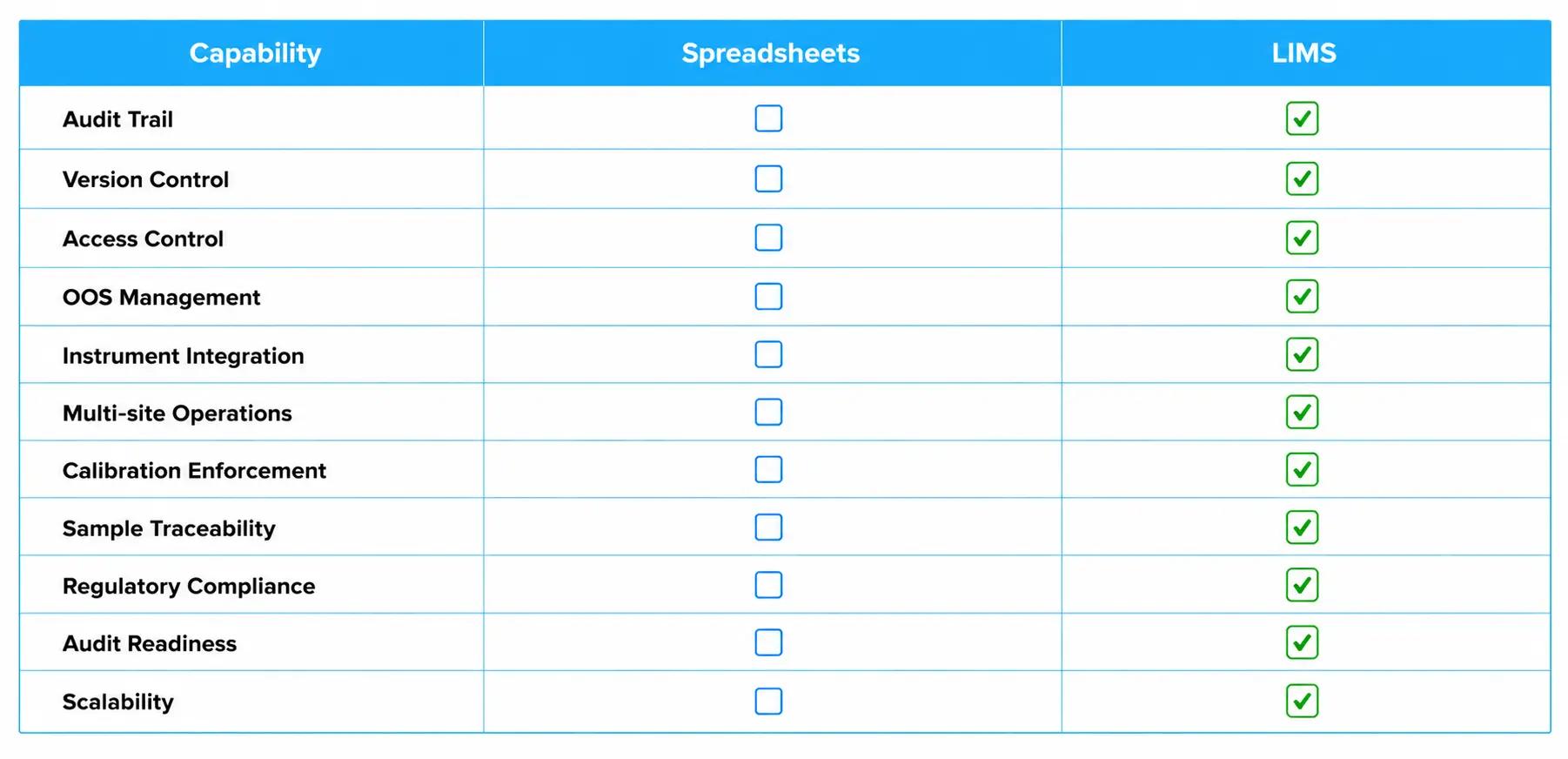
Spreadsheets vs LIMS Software: A Direct Comparison
From Spreadsheet to LIMS: In 4 Stages
Laboratory digital transformation from spreadsheet to LIMS does not need to happen all at once. A phased migration approach reduces disruption, maintains operational continuity, and allows the laboratory to build confidence with each stage before moving to the next.
The first stage is master data preparation, which involves structuring all existing specification data, instrument records, analyst profiles, and product configurations into the clean, organised format the Laboratory Information Management System (LIMS) software will use. This is the most painstaking stage but the most important, because the quality of the data determines the quality of everything the LIMS produces.
The second stage is core system go-live, typically covering sample registration, test assignment, result entry, and approval workflow. This replaces the most critical spreadsheet functions immediately and begins generating the compliant audit trail and version-controlled records that regulated environments require.
The third stage is instrument integration, connecting analytical instruments to the LIMS via RS232 or TCP/IP to eliminate manual result transcription entirely. This is where laboratory data errors caused by transcription drop to effectively zero.
The fourth stage is expansion, adding modules for instrument qualification management, inventory management, training and competence certification, environmental monitoring, and stability study management that builds on the data foundation established in the previous stages.
Agaram's Qualis LIMS is designed to support exactly this phased implementation approach, with pre-built, configurable modules that can be activated progressively without disrupting the laboratory's ongoing operations. Its no-code configuration capability means QA managers can adapt registration templates, workflows, and report formats to match existing laboratory processes, which significantly reduces the transition.
Conclusion
The Hidden Costs of Staying on Spreadsheets
While spreadsheets may seem inexpensive, the hidden costs of manual data entry, error correction, audit preparation, compliance remediation, delayed batch releases, and data integrity risks quickly outweigh the perceived savings. As laboratories scale operations and face increasing regulatory scrutiny, spreadsheet-based workflows become a growing source of inefficiency, compliance exposure, and operational risk.
Modern laboratories require traceable, centralised, and audit-ready data management that spreadsheets cannot reliably provide. With cloud-based LIMS platforms, laboratories can accelerate implementation, reduce infrastructure costs, enable secure access across sites, and scale operations without the complexity of managing local systems. So, the question is no longer whether laboratories should move beyond spreadsheets, but how quickly they can make the transition to a connected laboratory informatics platform.
Explore how Agaram's Qualis LIMS can replace your spreadsheet-based workflows with a compliant, connected, audit-ready laboratory management platform - Book your personalised LIMS software demo today!
- Introduction
- Why Spreadsheets Fail Modern Laboratories
- Spreadsheets vs LIMS Software: A Direct Comparison
- From Spreadsheet to LIMS: In 4 Stages
- Conclusion

Related articles

Data Traceability in Laboratories: Why It Matters
What Is Laboratory Traceability Laboratory traceability is the ability to trace the complete history of a s...

Clinical Research Data Management Best Practices
Managing Clinical Data Clinical research produces an immense and steadily growing volume of data across eve...

Managing Clinical Trial Samples with LIMS
Introduction: From Patient to Proof Clinical trial sample management is far more complex than routine labor...
 Contact Us