
ALCOA+ Data Integrity Principles for Pharmaceutical QC: A Practical Guide
 Request a Demo
 Download Brochure
What Data Integrity Means in Pharmaceutical QC
Data integrity in pharmaceutical quality control refers to the accuracy, consistency, and reliability of data throughout its lifecycle. Every test result, observation, and calculation generated in a QC lab contributes to decisions about product quality and safety. Because of this, regulators expect that laboratory data can be trusted without ambiguity or interpretation gaps.
This means data must be complete, traceable, and protected from unauthorized changes. Any weakness in data integrity can lead to incorrect conclusions, which may ultimately affect product quality and patient safety. QC laboratories often handle large volumes of data from multiple instruments, analysts, and systems, making consistent data governance both critical and challenging.
Ensuring integrity across all these touchpoints requires not just policies, but a structured framework that can be applied in day- to- day operations. This is where ALCOA+ becomes essential.
Understanding the ALCOA and ALCOA+ Framework
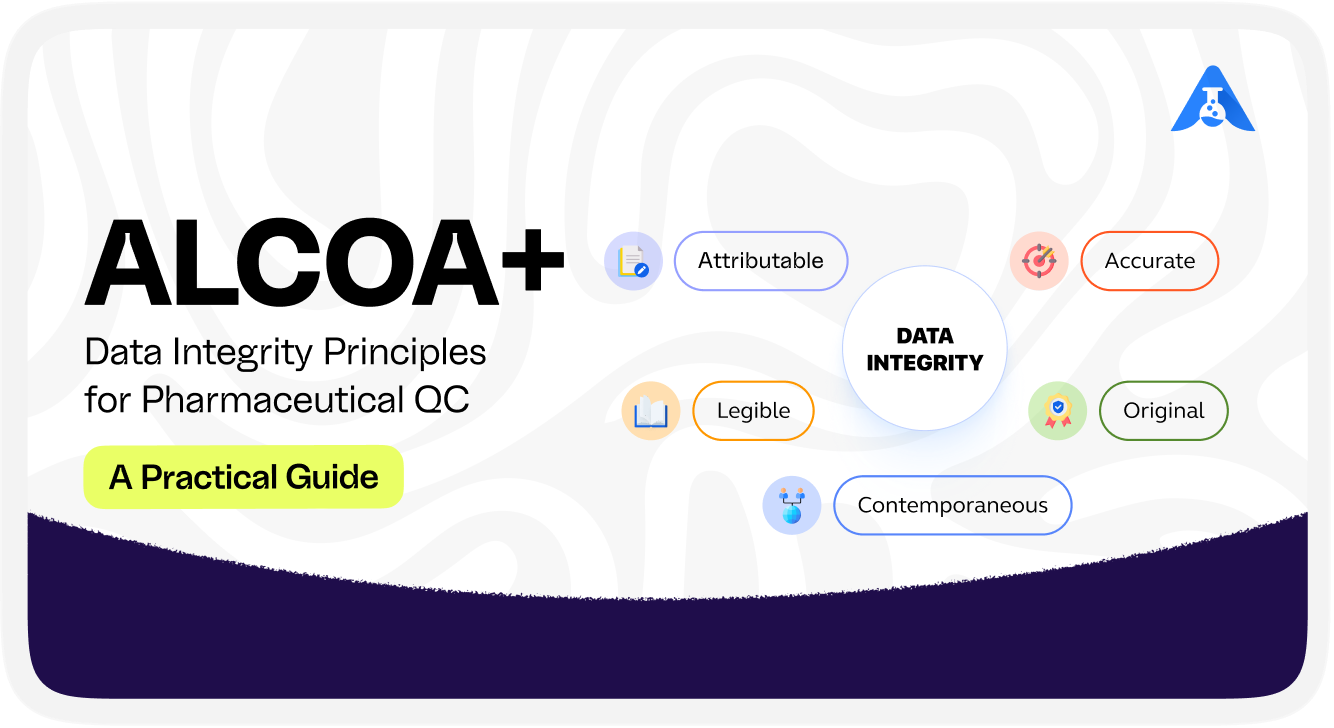
The ALCOA framework was introduced to define the fundamental attributes of reliable data. It stands for Attributable, Legible, Contemporaneous, Original, and Accurate. Over time, regulatory expectations evolved, and additional attributes were introduced to address increasing complexity in data handling. This expanded framework is known as ALCOA+.
ALCOA+ includes four additional principles: Complete, Consistent, Enduring, and Available. Together, these nine attributes form a comprehensive model that defines how data should be generated, recorded, stored, and reviewed in regulated environments.
Rather than being theoretical concepts, these principles are intended to guide practical implementation. They influence how laboratories design workflows, configure systems, and train personnel to ensure that data remains reliable from creation to archival.
Why Regulators Emphasize ALCOA+ Principles
Regulatory agencies place strong emphasis on ALCOA+ because it directly reflects the reliability of laboratory data. During inspections, data integrity is often evaluated through this framework, even if not explicitly stated. Inspectors assess whether records are attributable, whether entries were made at the correct time, and whether all relevant data has been retained.
When data fails to meet ALCOA+ expectations, it raises broader concerns about the effectiveness of quality systems. This can lead to observations, warning letters, or increased scrutiny in future inspections.
At the same time, ALCOA+ provides a consistent standard across the industry. By aligning with these principles, pharmaceutical laboratories can meet global regulatory expectations and reduce ambiguity in compliance interpretation.
Breaking Down Each ALCOA+ Principle
Each component of ALCOA+ represents a specific requirement for data reliability, and together they form a complete picture of compliant data practices.
Attributable means that every data point is linked to the individual who generated or modified it. This ensures accountability and traceability. Legible requires that data is clear and readable, whether it is captured electronically or on paper, so that it can be understood during review. Contemporaneous emphasizes that data must be recorded at the time the activity occurs, reducing the risk of errors caused by delayed entry.
Original refers to the preservation of the first recorded data or a verified true copy, ensuring that no critical information is lost or altered. Accurate means that data reflects the true value without errors, manipulation, or bias.
The additional principles strengthen this foundation. Complete ensures that all data, including repeats, reanalysis, and deviations, is captured and retained. Consistent requires that data follows a logical sequence and chronological order across records. Enduring focuses on long term preservation, ensuring that data remains intact and readable over time. Available means that data can be retrieved quickly for review, audit, or inspection.
These principles collectively define what trustworthy data looks like in a regulated QC environment.
Common Data Integrity Risks in QC Laboratories
Despite clear regulatory expectations, QC laboratories often face recurring data integrity risks. One of the most common issues is reliance on manual data entry, which increases the likelihood of transcription errors and inconsistencies.
Paper based documentation further complicates control. Records can be misplaced, damaged, or altered without adequate tracking, making it difficult to ensure completeness and traceability.
Standalone instruments present another challenge. When systems are not integrated, data may be stored locally or transferred manually, creating gaps in the data lifecycle. This makes it harder to demonstrate that all relevant information has been captured and preserved.
User access control is another area where risks emerge. Shared credentials or poorly defined roles reduce accountability and make it difficult to attribute actions to specific individuals. In addition, audit trails are often underutilized. Even when systems capture data changes, lack of regular review means potential issues may go unnoticed.
How ALCOA+ Applies to Daily Lab Operations
ALCOA+ principles must be applied consistently in everyday laboratory activities to be effective. During analytical testing, data should be recorded immediately to meet the contemporaneous requirement. Delayed entries or reliance on temporary notes can compromise both accuracy and traceability.
Direct data capture into controlled systems is another important practice. Entering results directly into validated software reduces the risk of transcription errors and ensures that original data is preserved.
Review processes should ensure completeness by including all results, even those that fall outside expected ranges or require reanalysis. This supports transparency and prevents selective reporting.
Consistency is achieved through standardized workflows and adherence to approved procedures. When processes are executed in a uniform manner, it becomes easier to maintain data integrity across different analysts and systems.
By embedding ALCOA+ principles into routine tasks, laboratories can ensure that compliance is maintained continuously rather than only during audits.
Challenges in Maintaining ALCOA+ Compliance
Maintaining ALCOA+ compliance can be complex, particularly in environments with high data volumes and multiple systems. Legacy infrastructure remains a major obstacle, as older instruments and software may not support modern compliance features such as secure audit trails or controlled access.
Training gaps also contribute to compliance challenges. If personnel do not fully understand how ALCOA+ principles apply to their work, they may unintentionally introduce risks through improper data handling practices.
Operational pressures in QC laboratories can lead to shortcuts, such as delayed documentation or incomplete records. These practices, while often driven by time constraints, directly undermine data integrity.
Additionally, integrating data from different sources requires careful management to ensure consistency and completeness. Without a unified approach, discrepancies can arise between systems, making it difficult to present a coherent data history.
Embedding Data Integrity Controls into QC Operations
Sustaining ALCOA+ compliance in a pharmaceutical QC environment depends on how effectively data integrity controls are integrated into routine laboratory workflows. Instead of treating data integrity as a separate compliance activity, it must be embedded into the scientific and operational design of laboratory processes.
Analytical methods should be executed according to validated procedures where data capture points are clearly defined. This ensures that observations, instrument outputs, and calculations are recorded in a structured and reproducible manner. Standard operating procedures should explicitly define when and how data is recorded, supporting contemporaneous and consistent practices across all activities.
System configuration is equally important. Laboratory software should enforce controls such as mandatory data fields, time stamped entries, and prompts for reason of change. These controls reduce variability in how data is handled and ensure that ALCOA+ principles are applied uniformly.
From a data lifecycle perspective, controls must extend from acquisition to archival. Instrument generated raw data should be captured directly or securely transferred into centralized systems to preserve originality and completeness. Data processing steps, including calculations and transformations, must remain transparent and fully traceable.
Periodic scientific review is essential to verify ongoing compliance. This includes evaluation of results, audit trail review, and trend analysis to ensure consistency and accuracy over time. Reviews should be risk based, focusing on critical processes and high impact data sets.
Personnel competency must also align with technical requirements. Analysts should be trained not only in test methods but also in correct data handling practices specific to their systems and workflows. This ensures that data integrity is maintained at the point of generation.
By embedding these controls into QC operations, laboratories can establish a more robust and scientifically grounded approach to ALCOA+ compliance, where data integrity is consistently maintained through system design and process discipline.
Conclusion
ALCOA+ principles provide a structured and practical framework for ensuring data integrity in pharmaceutical QC laboratories. They define the essential characteristics of reliable data and guide how it should be managed throughout its lifecycle.
For QC teams, consistent application of these principles is critical for meeting regulatory expectations and ensuring product quality. While challenges such as legacy systems and operational pressures exist, they can be addressed through a combination of well defined processes, effective training, and appropriate digital solutions.
Ultimately, data integrity is not just a regulatory requirement but a foundation for scientific reliability and trust. By embedding ALCOA+ principles into everyday operations, pharmaceutical laboratories can create a controlled, transparent, and inspection ready environment that supports both compliance and quality excellence.
- What Data Integrity Means in Pharmaceutical QC
- Understanding the ALCOA and ALCOA+ Framework
- Why Regulators Emphasize ALCOA+ Principles
- Breaking Down Each ALCOA+ Principle
- Common Data Integrity Risks in QC Laboratories
- How ALCOA+ Applies to Daily Lab Operations
- Challenges in Maintaining ALCOA+ Compliance
- Embedding Data Integrity Controls into QC Operations
- Conclusion